How Does a Centrifugal Compressor Work?

If you work with industrial gas systems, you’ve likely encountered the term centrifugal compressor. But how does a centrifugal compressor work, exactly? The answer lies in a fundamental physics principle: converting velocity into pressure. Unlike a piston compressor that physically squeezes gas in a shrinking chamber, a centrifugal compressor is a dynamic machine that accelerates the gas first, then trades that speed for a pressure rise.

Let’s walk through the process step by step, break down the role of each component, and clarify the science with a simple analogy.

The Core Principle: It's About Energy Conversion

Before diving into the stages, understand the “why.” A centrifugal compressor doesn’t directly compress gas at the impeller. Instead, it performs a two-step energy transfer:

  1. Mechanical Energy → Kinetic Energy: The impeller adds velocity to the gas.

  2. Kinetic Energy → Pressure Energy: The diffuser slows the gas down, forcing the kinetic energy to convert into potential energy in the form of pressure.

This continuous, high-velocity process is why these machines deliver a smooth, pulsation-free flow.

Step-by-Step Breakdown: The Gas Path

Let’s trace the journey of a gas molecule through the machine. This is the core of “how a centrifugal compressor works.”

Step 1: Suction Inlet (The Eye of the Impeller)

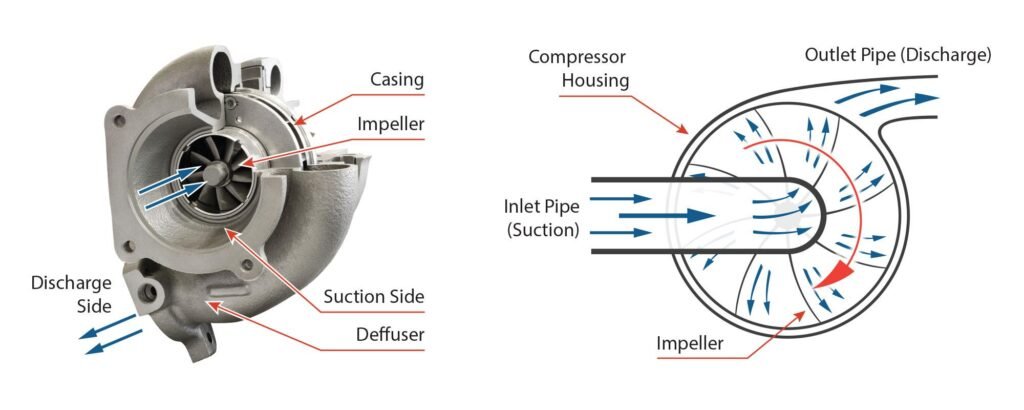
The process begins at the **suction inlet**. Gas is drawn axially into the very center of the first stage, a region called the “eye” of the impeller. At this point, the gas is at its lowest pressure and velocity in the compression cycle. Inlet guide vanes may be used here to pre-swirl the gas, optimizing the flow angle for efficiency at different operating loads.

Step 2: The Impeller (Velocity Generation)

This is the dynamic heart of the machine. The impeller is a rotating disc with precisely curved vanes. As the shaft spins at extremely high speeds (often 10,000+ RPM), the vanes grab the gas and fling it radially outward.

  • The Action: The gas is rapidly accelerated from the low-velocity “eye” to a very high velocity at the impeller’s outer rim (the tip).

  • The Analogy: Think of a spinning umbrella. If you spin it fast, water droplets fly off tangentially at high speed. The centrifugal force propels them. The impeller does this with gas, only contained within a casing.

Important: At this stage, pressure has only increased moderately. The primary gain is in immense velocity.

Step 3: The Diffuser (Pressure Generation)

Now comes the critical conversion. The high-speed gas bursts from the impeller tip straight into the diffuser. The diffuser is a stationary, radial passage that gets wider as it goes. As the gas flows through this expanding channel, it is forced to decelerate.

  • The Principle: Bernoulli’s principle tells us that as fluid velocity decreases in a diverging passage, its static pressure increases.

  • The Result: The kinetic energy painstakingly generated in the impeller is now efficiently converted into the high pressure that you need at the discharge.

Step 4: The Volute or Collector (Gas Collection)

After the diffuser, the gas, now at high pressure but still moving relatively fast, enters the volute casing. The volute is a spiral-shaped scroll surrounding the diffuser. Its job is simple: to collect the gas smoothly and further decelerate it slightly before directing it toward the discharge nozzle. In a multi-stage compressor, the volute would instead use a return channel to guide the gas back to the eye of the next impeller for further compression.

The Key Enemy: Understanding Surge

You can’t fully explain “how it works” without mentioning its primary operational risk: surge.
Because the compressor is a dynamic machine, it needs a minimum gas velocity to keep pushing gas forward. If the downstream pressure becomes too high, or the inlet flow drops too low, the flow can momentarily reverse. This violent back-and-forth oscillation is called surge. It causes massive vibration, bearing damage, and potential seal failure. Anti-surge control systems protect the machine by automatically recycling gas to the inlet, ensuring the compressor always stays safely above its minimum required flow rate.

Key Components That Make It Work

To summarize the machine’s operation, here are the essentials:

  • Impeller: The accelerator. Adds kinetic energy.

  • Diffuser: The converter. Turns velocity into pressure.

  • Shaft & Bearings: The support system handling radial and thrust loads at high speed. Modern designs often use magnetic bearings for oil-free, low-resistance operation.

  • Seals: Internal labyrinth seals minimize leakage back from the discharge to the suction, while dry gas seals prevent process gas from escaping the casing into the atmosphere.

A Simple Analogy to Tie It All Together

Still visualizing it? Combine two everyday ideas:
Imagine a garden sprinkler spinning very fast—that’s the impeller, throwing water (gas) outward at high speed. Now, point that high-speed water spray into a large, widening funnel. As the water spreads out and slows down inside the funnel, its pressure builds. That funnel is your diffuser. A centrifugal compressor is this exact sequence, engineered for high pressure ratios with aerodynamic precision.

Conclusion

Understanding how a centrifugal compressor works means understanding a single elegant energy trade-off: speed for pressure. The impeller does the work to make the gas fast, and the diffuser takes that speed and turns it into the force needed for industrial applications, from LNG liquefaction to large-scale air separation.

Need to apply this knowledge to a real-world project? If you’re selecting a compressor and need to size a unit for your specific gas and pressure conditions, contact our team for an engineering consultation.


发表评论

您的邮箱地址不会被公开。 必填项已用 * 标注