
How to Select a Centrifugal Compressor for Large Flow Applications

Selecting a centrifugal compressor for a large-flow application is not simply a matter of choosing the largest available model. In steel plants, chemical plants, gas processing facilities, and other continuous-duty industries, an incorrect selection can lead to high energy consumption, unstable operation, insufficient capacity, or excessive maintenance costs. The compressor should be selected according to the complete operating conditions rather than flow rate alone.
1. Start with Flow Rate and Operating Range
Flow rate is the first key parameter, but the operating range is equally important. Engineers should define the normal, minimum, and maximum flow requirements and determine whether the compressor will operate continuously or under varying loads.
For large-flow applications, centrifugal compressors are often suitable because they can provide high gas volumes with continuous operation. However, the selected compressor must maintain stable performance across the required operating range and provide sufficient margin against surge.
2. Check Suction and Discharge Conditions
Suction pressure, discharge pressure, and temperature directly determine the compressor’s required pressure ratio and head. A small change in inlet pressure or temperature can significantly affect compressor performance and power consumption.
The basic selection process should therefore consider:
Flow Rate → Suction Pressure → Discharge Pressure → Temperature → Required Head → Power
For process gas applications, gas composition and molecular weight must also be included because different gases require different aerodynamic and mechanical designs.
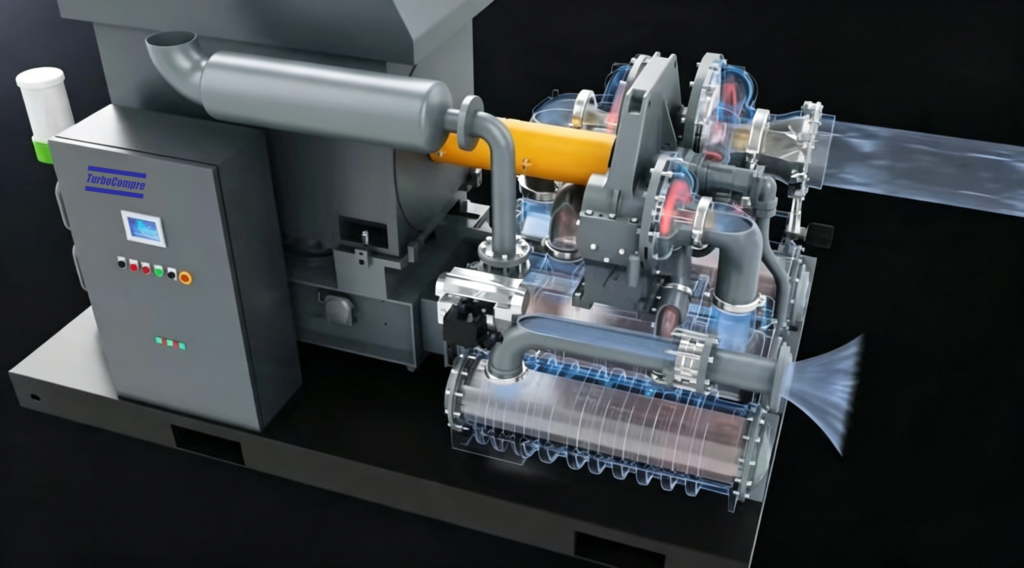
3. Consider Gas Properties and Application Conditions
Air and process gases cannot always use the same compressor configuration. Gas density, molecular weight, compressibility, temperature, corrosiveness, and required purity can all affect compressor selection.
For applications involving nitrogen, oxygen-enriched gas, hydrogen, CO₂, or other process gases, sealing, materials, cooling, and safety requirements may also become important design considerations.
4. Efficiency and Power Consumption Matter
For a large centrifugal compressor, energy consumption can represent a significant part of the equipment’s lifecycle cost. Compressor efficiency should therefore be evaluated together with the expected operating point.
Important factors include:
- Compressor aerodynamic efficiency
- Motor power
- Inlet and outlet pressure losses
- Cooler performance
- Operating load
- Part-load efficiency
A compressor that meets the required flow and pressure but consumes excessive power may result in a much higher total cost over years of operation.

5. Turbocompre for Large-Flow Centrifugal Compressor Applications
Turbocompre designs and manufactures centrifugal compressors for large-flow air and process-gas applications. Depending on the project, solutions can be developed around the customer’s flow rate, pressure ratio, gas properties, cooling requirements, and operating conditions.
Turbocompre also supports centrifugal compressor spare parts, cooler replacement, impeller manufacturing, overhaul, and performance-related services, providing a broader solution when customers need both new equipment and long-term support.
This integrated approach is particularly useful when replacing an existing compressor or developing a new system where equipment performance, reliability, and lifecycle cost all need to be considered together.

Planning a large-flow centrifugal compressor project? Contact Turbocompre with your operating parameters for a customized compressor solution.