
Centrifugal Compressor Discharge Pressure Drop: Common Causes and Troubleshooting
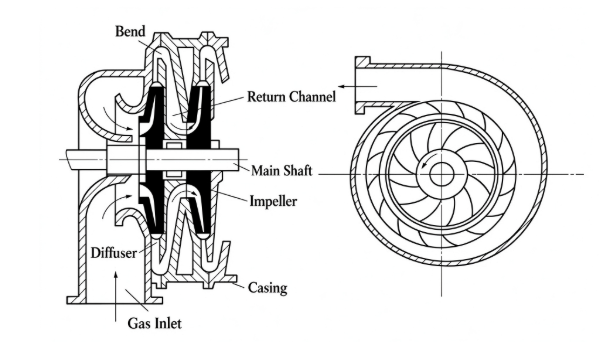
A centrifugal compressor discharge pressure drop is a common operating issue in industrial compression systems. It can affect downstream gas supply and overall process stability. The cause may not always be the compressor itself. Changes in inlet pressure, inlet temperature, flow rate, speed, gas composition, or downstream piping can all reduce discharge pressure. Internal issues such as impeller fouling, wear, diffuser degradation, and seal leakage can also reduce compressor head over time.
Therefore, a pressure drop should not immediately be treated as a compressor failure. Multiple operating parameters should be checked together. This article explains the main causes of centrifugal compressor discharge pressure drop, how to identify them, and what corrective actions can be taken.
I. What Does a Centrifugal Compressor Discharge Pressure Drop Mean?
In chemical, petrochemical, air separation, metallurgy, power generation, and industrial gas applications, discharge pressure is a key operating parameter. It directly affects downstream gas supply and process stability.
A discharge pressure drop does not necessarily mean that the compressor itself has failed. Changes in upstream supply, higher downstream demand, or different gas properties can cause the pressure to change even when the compressor is mechanically healthy.
If the pressure drop is accompanied by changes in flow, power, vibration, or operating temperature, further investigation is required. First verify the pressure measurement, then compare inlet pressure, discharge pressure, inlet temperature, flow rate, speed, and motor power to determine whether the problem comes from the process, control system, or compressor components.
II. Main Causes of Centrifugal Compressor Discharge Pressure Drop
1. Lower Inlet Pressure or Higher Inlet Temperature
One of the most common causes is a change in inlet conditions. Lower inlet pressure affects the compressor suction condition and the achievable discharge absolute pressure. Insufficient upstream supply, higher inlet piping resistance, a clogged filter, or a partially closed inlet valve can all reduce inlet pressure.
If both inlet and discharge pressure decrease, the upstream supply system should be checked first rather than assuming a compressor failure.
Higher inlet temperature can also affect compressor performance. Gas density can be expressed as:
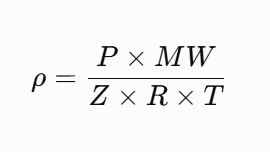
where P is absolute pressure, Z is the compressibility factor, R is the specific gas constant, and T is absolute temperature. When pressure and gas properties remain relatively stable, higher temperature reduces gas density and changes the compressor operating condition. Therefore, inlet pressure and inlet temperature should be monitored together when investigating a discharge pressure drop.
2. Higher Flow Rate or Lower Compressor Speed

Centrifugal compressor head is closely related to flow rate and rotational speed. When actual flow increases and moves toward the high-flow region of the performance curve, the available compressor head may decrease, resulting in lower discharge pressure.
In this situation, compare flow rate, motor power, and discharge pressure while checking downstream gas demand and valve positions.
Lower rotational speed can also reduce compressor head. Under similar operating conditions, head is approximately proportional to the square of speed. A lower VFD frequency, motor problem, drive failure, coupling issue, or control-system speed limit may therefore reduce discharge pressure.
3. Performance Degradation of the Impeller, Diffuser, or Seals
If inlet conditions and speed remain stable but discharge pressure gradually decreases over time, the compressor internal components should be inspected.
An impeller handling dusty, oily, or corrosive gas for long periods may develop fouling, wear, or corrosion. These changes affect the impeller flow path, increase flow losses, and reduce compressor head and efficiency.
The diffuser and other stationary flow-path components also affect pressure recovery. Fouling, blockage, corrosion, or deformation can prevent efficient conversion of the high-velocity gas leaving the impeller into static pressure.
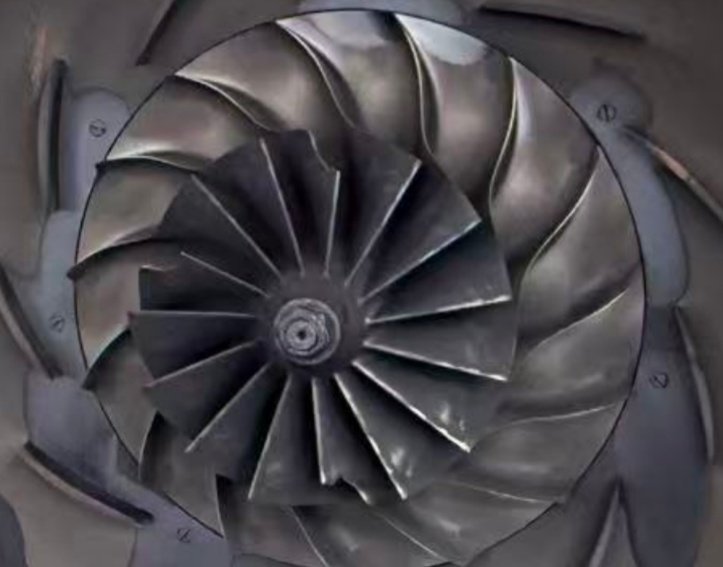
Increased seal clearance can cause higher internal leakage. As labyrinth seals and other sealing components wear, more high-pressure gas can leak through the increased clearance, reducing the compressor’s effective compression capacity. This type of problem usually develops gradually and should be evaluated using operating trends and inspection data.
4. Changes in Gas Composition or Properties
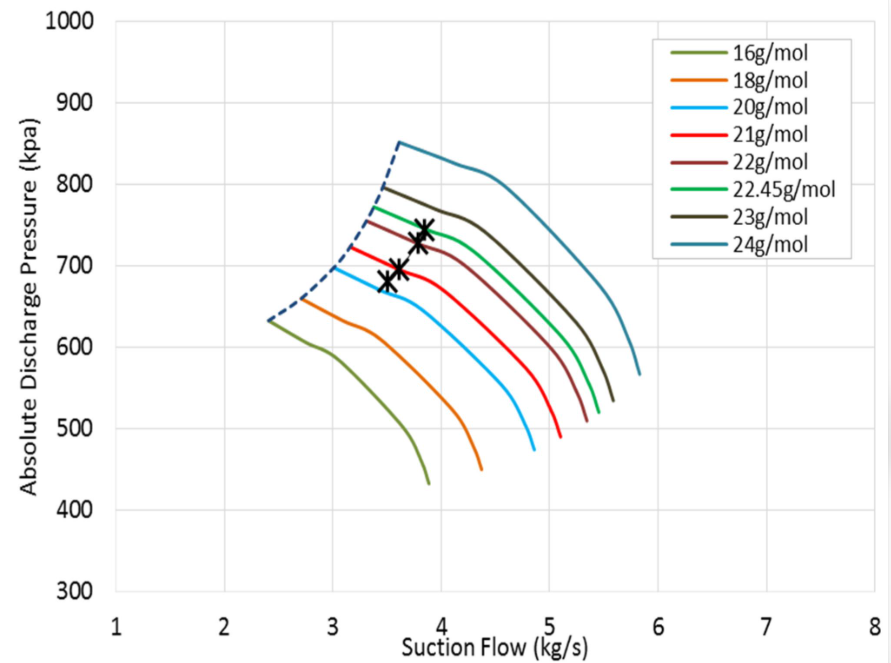
Changes in gas composition can also affect compressor performance, especially in natural gas, mixed industrial gases, and chemical process gases.
Gas molecular weight, compressibility factor Z, and specific heat ratio all affect gas density and the compression process. If actual gas properties differ significantly from the design conditions, discharge pressure and the operating point may change even when the compressor is mechanically healthy.
If the pressure drop occurs after a feed-gas change or process adjustment, the actual gas properties should be checked against the compressor design conditions and performance curve.
5. Higher Downstream Demand or Piping Problems
A discharge pressure drop does not always originate from the compressor. Higher downstream gas demand, changes in outlet valve position, an unintentionally open bypass valve, or pipeline leakage can all reduce system pressure.
If the compressor operating parameters remain normal while downstream pressure continues to fall, inspect the outlet piping, valves, bypass system, and actual gas demand. Distinguishing compressor performance degradation from system load changes can prevent unnecessary compressor disassembly.
III. How to Identify the Cause of a Centrifugal Compressor Discharge Pressure Drop
A discharge pressure drop should not be diagnosed from one parameter alone. Operating data and historical trends should be compared to narrow down the possible cause.
| Operating Symptom | Possible Cause | Priority Check |
|---|---|---|
| Inlet and discharge pressure both decrease | Insufficient upstream supply or higher inlet resistance | Supply system, filter, inlet valve |
| Inlet temperature increases significantly | Ambient or cooling condition changes | Inlet temperature, cooling system |
| Flow increases while discharge pressure drops | Higher downstream demand or operating-point shift | Flow, valve position, performance curve |
| Speed and pressure both decrease | Drive or control-system issue | Motor, VFD, coupling, control settings |
| Pressure gradually decreases over time | Impeller fouling, wear, or increased seal clearance | Impeller, diffuser, seals |
| Pressure drops with increased vibration | Rotor, impeller, or bearing issue | Vibration trend, rotor, bearings, coupling |
| Pressure changes after gas composition changes | Gas properties differ from design conditions | Molecular weight, gas composition, compressibility factor |
| Compressor parameters remain normal but downstream pressure drops | Pipeline leakage, valve issue, or higher demand | Outlet piping, bypass valve, downstream system |
The timing and rate of the pressure change are also important. A sudden pressure drop should first prompt checks of valves, control settings, inlet supply, and the drive system. A gradual pressure drop is more likely to require inspection of impeller fouling or wear, flow-path contamination, and seal performance.
These patterns are useful for initial diagnosis, but the final assessment should be based on actual operating data and the compressor performance curve.
IV. How to Correct a Centrifugal Compressor Discharge Pressure Drop
Before taking corrective action, verify the pressure instruments and measurement points, then compare the current operating condition with the design condition. Different causes require different solutions. Simply increasing speed or adjusting a valve to force pressure recovery is not an appropriate general solution.
If the problem comes from the inlet conditions, check upstream gas supply, inlet piping, filter differential pressure, and inlet valves. If inlet temperature is too high, inspect the cooling system, ambient conditions, and related process parameters.
If flow has increased or speed is abnormal, compare the actual operating point with the compressor performance curve. Check the VFD setting, motor condition, and control logic. Any adjustment should remain within the compressor’s operating limits, with the anti-surge system functioning properly. Proper capacity control is important for maintaining stable and efficient compressor operation.
If internal performance degradation is suspected, inspect the relevant components. Mild fouling may be suitable for cleaning. Severe impeller wear, corrosion, or structural damage may require repair or replacement. Diffusers and other flow-path components should be checked for fouling, deformation, and damage. Seal clearances should be restored or the seals replaced when they exceed allowable limits.
- If the problem comes from the downstream system, inspect pipeline leakage, bypass valves, outlet valves, and actual gas demand. Identifying the source of the pressure loss first can prevent unnecessary disassembly, improper adjustments, and unnecessary spare-parts replacement.

V. Key Parameters to Check When Discharge Pressure Drops
To improve troubleshooting efficiency, the following operating parameters should be monitored and recorded:
Inlet and discharge pressure: Identify whether the pressure change originates upstream, inside the compressor, or downstream.
Inlet and discharge temperature: Identify changes in gas conditions and support compression-process analysis.
Flow rate: Determine whether the compressor has moved away from its normal operating range.
Speed and motor power: Check the drive condition and operating load.
Vibration and bearing temperature: Help identify potential rotor, bearing, and mechanical problems.
Anti-surge valve position and control signals: Identify recycle flow, control actions, or operating-point changes.
Gas composition and properties: For process gases, check molecular weight, compressibility factor, and other relevant properties.
Current data should ideally be compared with historical operating data, the compressor performance curve, and the original design parameters. A single parameter is rarely sufficient to confirm a fault. The relationship between pressure, flow, speed, and power usually provides a more reliable basis for troubleshooting.
A centrifugal compressor discharge pressure drop does not necessarily mean that the complete unit must be replaced. If the problem involves the impeller, seals, bearings, diffuser, or other components, operating data and inspection results can be used to determine whether cleaning, repair, or spare-parts replacement can restore performance.

Turbo Compre specializes in centrifugal compressor complete units and spare parts, including key components such as impellers, seals, bearings, and diffusers. We provide technical evaluation and replacement support based on actual compressor operating conditions and component requirements.
For spare-parts replacement or technical evaluation, it is recommended to provide the compressor model, inlet and discharge pressure, flow rate, inlet temperature, rotational speed, gas composition, and observed symptoms. This information helps support a more accurate technical assessment.