Contents
Show
How to Read Air Compressor Specification Sheet Correctly
Most factory purchasers and maintenance staff struggle with complex technical data. Air compressor specification determines equipment performance, energy consumption and service life. Incorrect reading of compressor specification often leads to insufficient pressure, high energy waste and frequent equipment faults.
This article simplifies how to read a compressor specification sheet. It covers nameplate checking, core parameters, model decoding and selection tips to help users choose a suitable air compressor machine.
1. Four Core Parameters on Compressor Specification
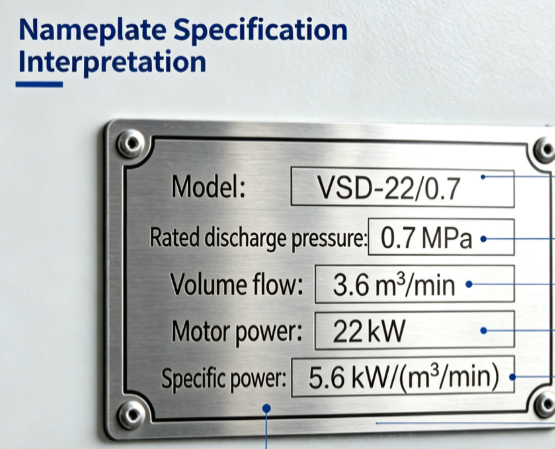
1.1 Rated Discharge Pressure
Discharge pressure refers to the rated working pressure of the unit, which decides the normal operation of pneumatic equipment. 1 MPa = 10 bar.
- 0.7 MPa (7 bar): standard industrial pressure for general processing, spraying and pneumatic tools
- 0.8 MPa (8 bar): suitable for long pipeline systems with obvious pressure loss
- 1.0–1.3 MPa: high-pressure type for laser cutting and special industrial equipment

Working pressure must be lower than rated pressure. It is recommended to reserve 0.1–0.2 MPa pressure margin to offset pipeline loss. Long-term overpressure operation will shorten service life and cause safety hazards.
Volume flow reflects the air production capacity of an air compressor machine. This data in air compressor specification judges whether the air supply meets factory consumption demands.
The marked flow data is tested under standard ambient conditions. High temperature and high altitude will reduce actual air output.
When selecting models, calculate the maximum instantaneous air consumption of all equipment, and reserve 10%–20% air volume allowance for pipeline leakage. Avoid long-term full-load operation of small-capacity units, which causes overload and high power consumption.
1.3 Rated Motor Power
Motor power reflects the driving power and energy consumption level of the air compressor . Common industrial specifications range from 7.5 kW to 110 kW.

Rated power is not equal to actual operating power. Actual power consumption decreases under no-load or light-load states. Variable-speed units automatically adjust power according to air demand to achieve energy savings.
Under the same pressure and flow, lower rated motor power means better basic energy efficiency, which can be verified with the specific power data on the compressor specification sheet.
Specific power is the core energy efficiency indicator in air compressor specification. It represents the power consumption required to produce per cubic meter of compressed air.
Under 7 bar working condition, first-class energy-saving compressors have a specific power ≤ 5.8 kW/(m³/min). The lower the specific power, the better the energy-saving effect.
Small differences in specific power will lead to huge long-term electricity cost gaps, which is the key standard for factory equipment selection.
2. Common Selection Pitfalls
- Avoid blindly choosing high-power models. Reserve 15% capacity margin to balance operation and avoid energy waste or long-term overload.
- Do not only focus on purchase price. Low-cost units usually have poor specific power, and long-term electricity expenditure far exceeds equipment price difference.
- Take nameplate data as the only standard. Do not trust exaggerated marketing data for equipment acceptance and inspection.
Reading air compressor specification correctly relies on official nameplate data and four core parameters. Discharge pressure matches application scenarios, air volume guarantees sufficient supply, motor power reflects load capacity, and specific power determines long-term energy-saving benefits.
Accurate interpretation of the compressor specification sheet helps factories avoid wrong selection, reduce operating costs and lower failure rates.
Turbo Compre provides professional customized air compressor solutions. We match suitable air compressor machine models according to actual workshop pressure, flow demand and production schedules. We support one-stop services including field survey, installation, commissioning and after-sales maintenance, helping enterprises reduce energy consumption and ensure stable production.