
Why Is Dynamic Balancing Important for Centrifugal Compressor Impellers?

The centrifugal compressor impeller is a high-speed rotating component. Its balancing quality directly affects compressor stability, reliability, and service life. Rotor imbalance can cause excessive vibration, increase bearing and seal loads, and in severe cases affect clearances and efficiency. Long-term imbalance may also increase the risk of fatigue damage.
I. What Is Dynamic Balancing of a Centrifugal Compressor Impeller?
The impeller transfers mechanical energy to the gas through high-speed rotation. Ideally, its mass should be evenly distributed around the rotational axis.
In practice, erosion, fouling, wear, material loss, and repair work can change the mass distribution and create eccentricity. At high speed, this produces periodic excitation force and results in rotor imbalance.
Dynamic balancing measures the amount and phase of imbalance and corrects it by adding or removing material. The goal is to keep residual imbalance within the specified limits.
Static balancing mainly addresses single-plane imbalance, while dynamic balancing also considers axial mass distribution and couple imbalance. For high-speed compressor rotors, static balancing alone is generally insufficient.
A multistage rotor may include shafts, impellers, sleeves, and balance discs. Therefore, a balanced individual impeller does not always mean the complete rotor is balanced. After replacement, disassembly, or repair, the complete rotor balance should be verified. Rotor balancing procedures for rotors with flexible behaviour are addressed in ISO 21940-12.

II. The Chain Effects of Impeller Imbalance
2.1 Excessive Vibration Is the Most Visible Symptom
An unbalanced impeller generates periodic excitation force, which is transmitted through the shaft and bearings. 1X rotational-frequency vibration is a common indicator of rotor imbalance.
Minor imbalance: vibration increases slightly and should be monitored.
Moderate imbalance: vibration may reach warning levels and become speed-related.
Severe imbalance: vibration may exceed protection limits and increase loads on bearings, seals, and couplings.
However, 1X vibration alone cannot confirm imbalance. Misalignment, shaft bending, coupling problems, and bearing faults can produce similar vibration. Diagnosis should consider amplitude, phase, shaft orbit, speed, and vibration trends.

2.2 Increased Bearing Loads
Rotor imbalance transfers additional dynamic loads to radial and thrust bearings. Long-term operation may affect oil-film stability and increase wear and fatigue risk.
Possible effects include:
Higher bearing dynamic loads;
Increased bearing wear;
Higher thrust bearing loads;
Further deterioration of rotor stability.

This may create a cycle:
Rotor imbalance → higher vibration and dynamic loads → bearing deterioration → reduced rotor stability
However, bearing problems can also result from lubrication, clearance, misalignment, oil-film instability, or installation issues.
2.3 Dry Gas Seal Damage and Leakage Risk
Severe rotor imbalance may increase radial vibration and shaft orbit changes, increasing the risk of abnormal seal loading or rubbing.
Possible consequences include:
Seal-face wear;
Abnormal seal clearance;
Increased process-gas leakage;
Dry gas seal failure in severe cases.
Seal leakage should not automatically be attributed to imbalance. Operators should also check rotor vibration, axial displacement, seal gas pressure, filtration, clearance, and seal condition.

2.4 Possible Effects on Efficiency and Energy Consumption
Dynamic imbalance mainly causes vibration and increased mechanical loads. If vibration or radial displacement becomes significant, it may affect seals and internal clearances, increasing leakage losses.At the same time, fouling, corrosion, wear, and deformation can affect both mass distribution and aerodynamic performance.
The relationship can be summarized as:
Imbalance → increased vibration/displacement → possible clearance or seal effects → increased losses → potential performance deterioration
For continuously operating compressors, even a small efficiency loss may increase specific energy consumption. Performance problems should therefore be evaluated together with impeller condition, clearances, seals, and aerodynamic parameters.
2.5 Fatigue Risk to the Impeller and Rotor
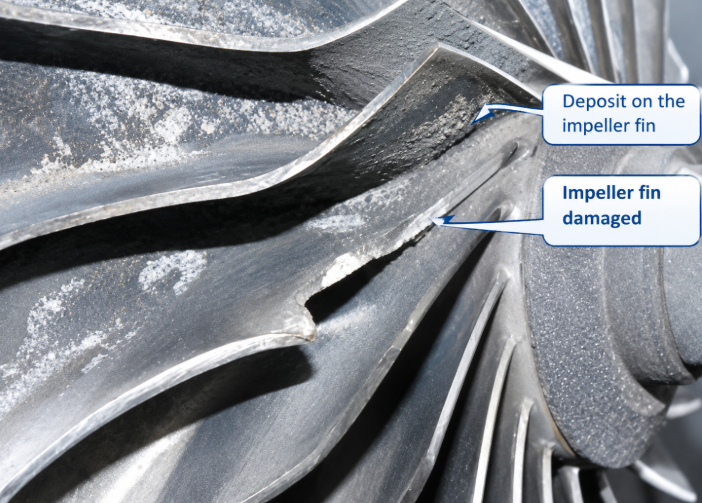
Long-term significant imbalance creates additional alternating stress in the impeller and shaft system. Under certain structural and material conditions, this can increase fatigue risk.
Potentially affected areas include:
Blade roots and stress-concentration areas;
Blade cracks or fracture;
Shaft-system fatigue damage.
These failures are not caused by imbalance alone. Material condition, design stress, manufacturing defects, operating conditions, rubbing, and fatigue cycles must also be considered.
Maintenance reminder: After erosion, fouling removal, blade repair, laser cladding, welding, grinding, or replacement, the impeller mass distribution may change. Dynamic balancing or balance verification should be performed according to the manufacturer’s requirements and applicable standards.
2.6 Effects on Auxiliary Components
Abnormal vibration can also reach couplings, anchor bolts, piping, and instrumentation, increasing fatigue and loosening risks.
Coupling diaphragms may suffer fatigue damage;
Anchor bolts and connections may become loose;
Instrument connections may become unstable;
Piping may experience vibration or resonance.
At the same time, piping vibration, loose foundations, and coupling damage can also become vibration sources. Therefore, troubleshooting should consider the entire compressor system.
III. When Is Dynamic Balancing Required?
Before installing a new impeller: Verify balance according to manufacturer requirements and applicable standards.
After impeller repair: Recheck balance after grinding, laser cladding, welding, or significant material removal.
After erosion, corrosion, or material loss: Check balance if mass distribution has changed significantly.
After severe rubbing or mechanical impact: Inspect the rotor and rebalance if necessary.
After rotor overhaul or impeller replacement: Verify the complete rotor balance.
When 1X vibration remains high: After excluding other mechanical causes, balance the rotor if imbalance is confirmed.
After long-term fouling: Check balance when uneven deposits cause significant mass redistribution.
Note: Passing an offline impeller balance test does not guarantee a balanced assembled rotor. For high-speed flexible rotors, field or complete-machine balancing may be required after assembly.
Dynamic balancing is more than a maintenance procedure. It is an important part of controlling high-speed rotor risks.Impeller imbalance can increase vibration and dynamic loads on bearings, seals, couplings, and other components. If it persists, it may also affect equipment reliability and performance. High-speed impellers are sensitive to residual imbalance. New, repaired, or significantly modified impellers should be balanced and verified according to applicable standards, such as API 617 where applicable, and manufacturer requirements. Regular vibration monitoring, together with control of inlet contaminants and prevention of fouling, erosion, and corrosion, helps maintain long-term rotor stability.

Turbo Compre specializes in centrifugal compressor research, development, and manufacturing, including the design, manufacturing, repair, and dynamic balancing of compressors, rotors, impellers, and other core components. Turbo Compre provides centrifugal compressor rotor spare parts, rotor overhaul, impeller repair, and dynamic balancing services for industries including petrochemical, steel and metallurgy, textile and fiber, pharmaceutical, and automotive manufacturing.