
How Does a Change in Gas Molecular Weight Affect Centrifugal Compressor Performance?
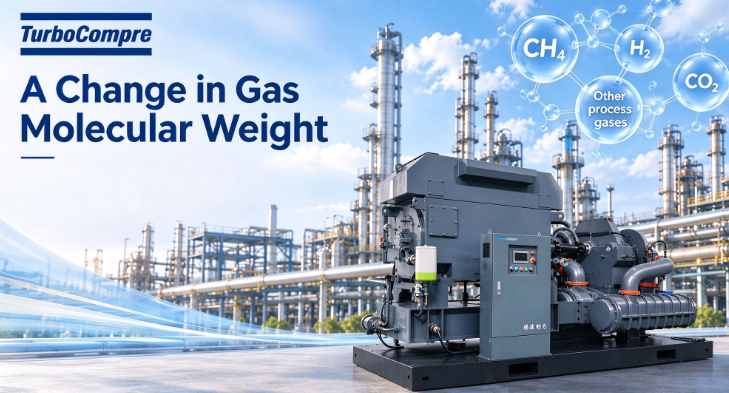
In natural gas, petrochemical, chemical, air separation, and other process gas compression systems, molecular weight is one of the key parameters affecting centrifugal compressor performance.
When the actual gas molecular weight deviates from the design value, the impact goes beyond whether the gas is lighter or heavier. Gas density, actual inlet volumetric flow, pressure ratio, head, efficiency, power consumption, discharge temperature, and surge margin may all change. For multistage centrifugal compressors, significant changes in gas composition may also affect the required number of impeller stages and the overall compressor selection.
Therefore, evaluating a centrifugal compressor under different gas conditions requires more than a single MW value. Gas composition, pressure, temperature, flow rate, and the compressor performance map must be considered together.
I. Why Does Gas Molecular Weight Affect Centrifugal Compressor Performance?
Gas molecular weight directly affects gas density.
For a real gas, density can be calculated using the following relationship:
Gas density = (P × MW) / (Z × R × T)
Where:
P = Absolute pressure
MW = Gas molecular weight
Z = Compressibility factor
R = Universal gas constant
T = Absolute temperature

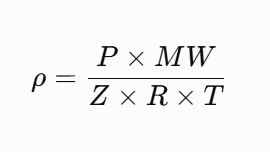
When pressure, temperature, and compressibility factor remain approximately constant, a higher MW generally results in higher gas density, while a lower MW results in lower gas density.
A centrifugal compressor impeller processes gas based on its actual volumetric flow. Therefore, changes in molecular weight affect gas density and, in turn, the compressor’s operating point.
The basic relationship can be summarized as follows:
Gas composition change → Molecular weight change → Density change → Actual volumetric flow change → Operating point shift → Changes in head, pressure ratio, efficiency, power, and operating range
Gas composition can significantly affect the aerodynamic and thermodynamic performance of a centrifugal compressor. MW, compressibility factor Z, and specific heat ratio k are all important variables.
II. Which Parameters Are Most Affected by Changes in Gas Molecular Weight?
The effects of changing gas molecular weight on centrifugal compressor performance can be summarized as follows:
Parameter | General trend when MW increases | General trend when MW decreases |
|---|---|---|
Gas density | ↑ | ↓ |
Actual specific volume | ↓ | ↑ |
Actual inlet volumetric flow (at fixed mass flow) | ↓ | ↑ |
Pressure ratio | May increase | May decrease |
Compressor head | May change | May change |
Compression efficiency | May change | May change |
Specific power / specific work | May change | May change |
Discharge temperature | May change | May change |
Surge margin | May decrease | May change |
Required number of stages | May change | May increase |
ASME PTC 10 provides methods for evaluating centrifugal compressor performance during testing, including gas properties, flow rate, pressure rise, head, shaft power, efficiency, surge point, and choke point.
III. Does a Lower Molecular Weight Always Reduce Power Consumption?
This is a common misconception in industrial applications. When gas molecular weight and density decrease, it is tempting to assume that less power will always be required to compress the lighter gas. However, this conclusion is incomplete.
For a centrifugal compressor, shaft power is not determined by molecular weight alone. It also depends on mass flow, compressor head, and efficiency.
Shaft power can be simplified as:
Pshaft ≈ (ṁ × H) / η
Pshaft = Shaft power
ṁ = Mass flow rate
H = Compressor specific head
η = Compressor efficiency
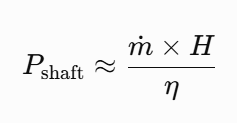
This relationship shows that a change in MW does not automatically mean that motor power will increase or decrease.
For example, at the same mass flow rate, a decrease in gas MW reduces gas density and increases actual inlet volumetric flow. The compressor operating point consequently shifts. If the new operating point moves away from the best-efficiency region, compressor efficiency may decrease. The head required to achieve the target discharge pressure may also change.
IV. Why Does a Change in Molecular Weight Shift the Compressor Operating Point?
The impeller dimensions, blade geometry, diffuser design, and rated speed of a centrifugal compressor are established according to its design conditions. When gas molecular weight changes, the gas entering these fixed flow passages has different properties, potentially shifting the original design operating point.
Consider a case in which mass flow remains constant. When gas MW decreases, gas density generally decreases, and actual volumetric flow can be expressed as:
Actual Volumetric Flow
Q = ṁ / ρ
Where:
Q = Actual volumetric flow rate
ṁ = Mass flow rate
ρ = Gas density
Effect of Molecular Weight Reduction
MW ↓ → Gas density ↓ → Actual inlet volumetric flow ↑
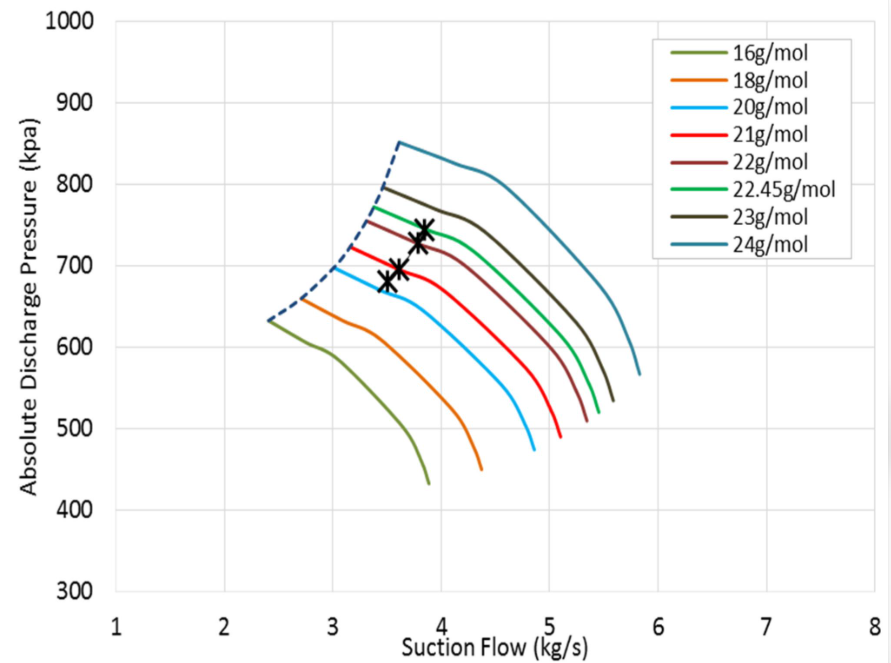
Although the process mass flow remains unchanged, the actual gas volume handled by the centrifugal compressor impeller increases.
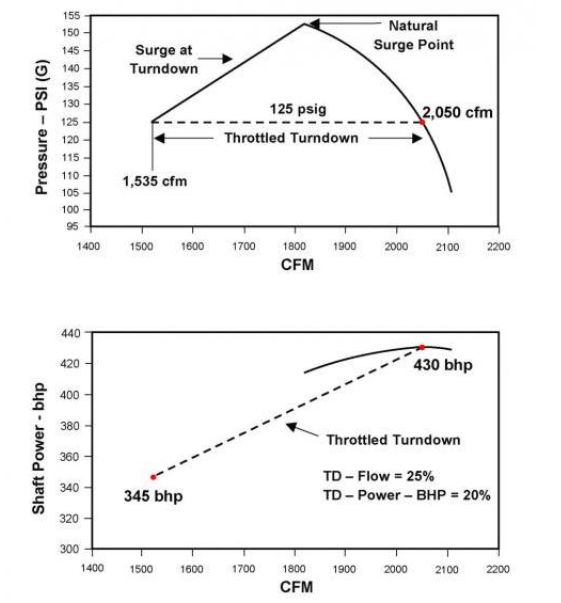
Because the compressor performance map is closely related to inlet volumetric flow, the operating point may move from its original design region toward a higher-flow region. If the change is substantial, the compressor may move away from its best-efficiency point or approach the limit of its operating range.
Molecular weight changes can also affect the pressure ratio and head that a compressor can develop at a given speed. For the same impeller under comparable operating conditions, a lower gas MW may reduce the achievable pressure ratio.
V. How Do Molecular Weight Changes Affect Efficiency, Discharge Temperature, and Surge Margin?

Different gases have different gas constants, specific heat ratios, compressibility factors, and speeds of sound. These differences affect the flow behavior of gas through the impeller and diffuser.
Therefore, actual performance calculations should consider not only MW but also the compressibility factor Z, specific heat ratio k, Mach number, and Reynolds number.
For industrial centrifugal compressors operating continuously, even a relatively small efficiency reduction can translate into a significant difference in long-term energy costs.
Surge margin also requires careful attention. The stable operating range of a centrifugal compressor is not fixed under all gas conditions. The operating point must maintain an adequate safety margin from the surge line.
If a change in gas composition shifts the operating point toward the surge region, the system may experience flow fluctuations, discharge pressure oscillations, increased vibration, or frequent anti-surge valve activation.
However, it is equally incorrect to assume that a higher MW always increases surge risk or that a lower MW necessarily moves the compressor closer to the surge line. The actual operating point depends on rotational speed, flow rate, inlet conditions, pressure ratio, and the compressor performance map.
For process gas centrifugal compressors, equipment suitability is determined not by an isolated MW value but by the match between the full range of gas operating conditions and the compressor performance characteristics.
If a project involves natural gas, hydrogen, synthesis gas, or other process gases with significant molecular weight variations, a more reliable approach is to provide the complete gas composition and operating range during the equipment selection stage rather than specifying only one design point.

If your project involves fluctuating gas molecular weight or requires centrifugal compressor selection for natural gas, hydrogen, synthesis gas, or other process gases, Turbo Compre can evaluate the operating conditions and support compressor performance calculations.
Provide the actual gas composition, MW, inlet pressure, inlet temperature, flow rate, and discharge pressure so that the engineering team can assess compressor suitability and recommend an appropriate technical solution.