
Variable-Load Operation of Centrifugal Units: IGV Regulation vs. Throttle Venting
Centrifugal compressors are core fluid delivery and energy conversion equipment widely used in chemical, HVAC, air separation, petrochemical and other industrial fields. These units frequently operate under variable load conditions due to fluctuating production capacity, ambient temperature changes and scheduling adjustments. The load regulation mode directly determines operational safety, energy efficiency, process stability and equipment service life. The two mainstream regulation methods on-site are inlet guide vanes (IGV) regulation and throttle venting regulation. This article systematically compares their working principles, performance differences and application scenarios to provide technical references for energy-saving optimization and equipment selection.
1. Working Principles of Two Regulation Modes
Centrifugal compressors feature a fixed-speed characteristic:flow rate, head and power are positively correlated. Variable-load regulation adjusts inlet or outlet flow to match system demand, and the two modes adopt completely different mechanisms.
1.1 Inlet Guide Vanes (IGV) Regulation
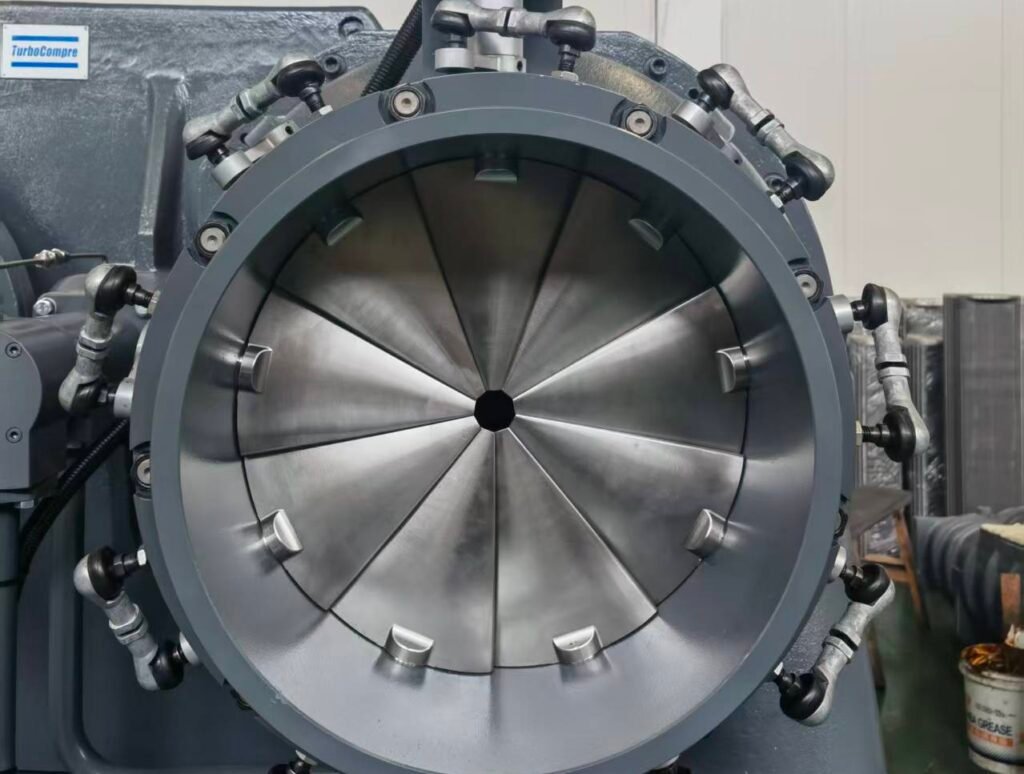
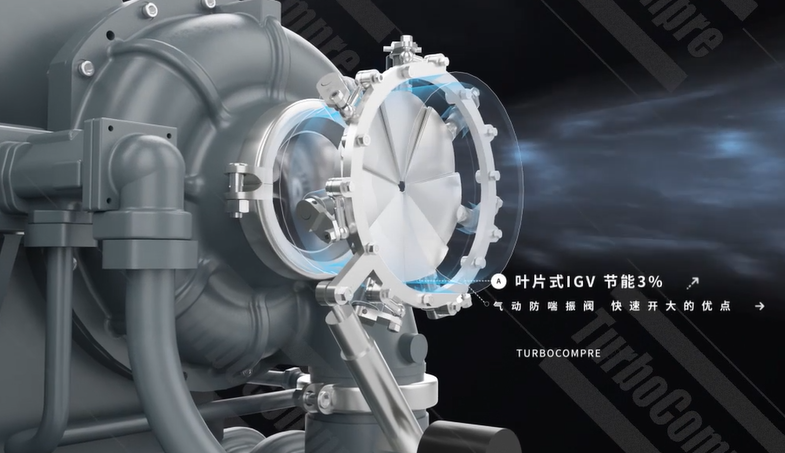
Inlet Guide Vanes regulation is an active load adjustment method for compressor units. Rotatable guide vanes installed at the first-stage impeller inlet adjust airflow angle and flow area via actuators. By generating pre-rotated inlet airflow, the impeller’s work efficiency is changed to precisely control unit flow, pressure and shaft power and adapt to variable production loads.
As load decreases, vanes close to enhance pre-rotation and reduce impeller work output. As load rises, vanes fully open to restore rated performance. This mode requires no gas venting and modifies the unit performance curve actively. Its stable regulation range covers 50%–100% of rated flow with high operational efficiency.

1.2 Throttle Venting Regulation
Throttle venting is a traditional passive regulation method, mainly divided into inlet throttling and outlet venting (the latter dominates on-site). The unit maintains nearly rated operating conditions, while excess compressed gas is vented or bypassed to match low-load production demand.
This method does not change the unit’s inherent performance characteristics. It consumes redundant energy through throttling resistance and gas venting. The unit runs at high speed and high compression ratio even under low load, causing massive invalid power consumption with poor overall energy efficiency, though it requires no unit modification.

2. Comprehensive Performance Comparison
This chapter compares the two modes from five key dimensions: energy efficiency, regulation accuracy, equipment safety, operation & maintenance cost, and working condition adaptability.
2.1 Energy Efficiency Comparison
Energy consumption difference is the core distinction between the two regulation modes and the key focus of compressor energy-saving renovation.
IGV regulation delivers excellent variable-load energy-saving performance. The unit shaft power decreases synchronously with load without invalid work or venting loss. Actual test data shows that at 72% rated flow, Inlet Guide Vane power consumption is only 63% of rated power, with more prominent energy-saving advantages at lower loads.
Throttle venting causes severe energy waste. Inlet throttling produces pressure loss, and outlet venting directly wastes compressed gas. At the same 72% load condition, venting regulation consumes 72% of rated power. Lower loads mean higher venting ratios and greater power and medium loss.
2.2 Regulation Accuracy and Dynamic Performance
Inlet Guide Vanes supports stepless continuous precise regulation with real-time vane fine-tuning, featuring fast response, high accuracy and stable pressure/flow output. It broadens the stable operating range, effectively suppresses surge, and adapts to frequent small-scale load fluctuations.
Throttle venting is rough regulation with valve hysteresis, easily causing system pressure and flow fluctuations and unstable production processes. It cannot optimize the surge boundary, requiring larger venting margins to avoid surge and further increasing energy waste, suitable only for low-precision, slowly changing load conditions.
2.3 Equipment Safety and Wear Comparison
Inlet Guide Vanes regulation matches the unit’s optimal operating conditions with uniform airflow and stable component stress. It avoids drastic pressure and temperature shocks, reduces wear on impellers, bearings and seals, and delivers low failure rate, long service life and high stability.
Throttle venting brings obvious equipment wear and safety risks. Frequent pressure fluctuations and airflow impact cause excessive vibration and noise, leading to weld fatigue, seal failure and bearing wear. Low-load high-compression operation raises discharge temperature, accelerates component aging and increases surge risk.

2.4 Initial Investment and O&M Cost
Inlet Guide Vanes regulation requires precision vanes, actuators and control systems, leading to higher initial transformation costs and regular calibration maintenance. However, its low energy consumption and low failure rate achieve lower full-life-cycle comprehensive costs.
Throttle venting features low initial investment and simple installation with standard valves and no unit modification. Nevertheless, frequent valve wear and leakage, combined with high long-term energy loss, result in much higher full-cycle O&M costs than IGV regulation.
2.5 Working Condition Adaptability
Inlet Guide Vanes regulation adapts to normal variable-load, frequent-fluctuation and high-precision processes. Its stable operating range covers 50%–100% rated load, widely applied in air separation, fine chemical, HVAC and refining industries.
Throttle venting is only applicable for equipment commissioning, trial production and intermittent operation. With low precision, high energy consumption and poor stability, it is unsuitable for long-term normal variable-load production.

3. Comprehensive Comparison Summary
|
Comparison Dimension |
IGV Regulation |
Throttle Venting Regulation |
|---|---|---|
|
Regulation Principle |
Active adaptation by adjusting inlet pre-rotation and unit work characteristics |
Passive load matching via throttling and venting redundant capacity |
|
Energy Consumption |
Low, power decreases synchronously with load, significant energy-saving effect |
High, severe invalid energy loss especially under low load |
|
Regulation Accuracy |
Stepless continuous adjustment, high precision and stable operation |
Rough adjustment, low accuracy, easy pressure and flow fluctuation |
|
Equipment Wear |
Minor wear, stable operation and long service life |
Severe wear with obvious vibration, high temperature and impact loss |
|
Initial Cost |
Relatively high, requires precision vanes and control systems |
Extremely low, simple structure and no unit modification |
|
Full-Cycle Cost |
Low, low energy consumption and less maintenance |
High, high energy, maintenance and shutdown costs |
|
Applicable Scenarios |
Long-term variable-load and high-precision production |
Short-term commissioning, temporary and low-precision production |
4. Industrial Application and Selection Suggestions
Based on the performance differences of the two modes, targeted selection and operation optimization suggestions are proposed:
1. Prioritize IGV regulation for normal variable-load production. For long-running units with frequent load fluctuations and high process requirements, IGV is the optimal solution. Despite higher initial investment, the renovation cost can be recovered within 1–2 years through energy savings with excellent full-cycle economic benefits.
2. Retain throttle venting only for temporary working conditions. It can be adopted for equipment commissioning, trial production and seasonal intermittent operation due to low cost and simple installation. However, long-term low-load operation should be restricted to avoid persistent energy waste and equipment aging.

3. Retrofit old units from venting to IGV regulation. For normally operating old units with throttle venting, install IGV systems to cancel regular venting operation. Reserve blow off valves only for emergency anti-surge and overpressure protection to balance energy saving and safety.
4. Adopt combined operation for complex conditions. For units with sharp load fluctuations, apply the composite mode of “IGV main regulation + blow off valve auxiliary stabilization”. IGV ensures energy-saving precision regulation under normal loads, and blow off valves assist stabilization under extreme low loads.
The essential difference between the two regulation modes lies in active energy-saving adaptation (IGV) and passive energy-consuming adaptation (throttle venting). Though simple and low-cost, throttle venting cannot meet modern industrial low-carbon and high-efficiency requirements due to high energy consumption and severe equipment loss. In contrast, IGV regulation has become the preferred mainstream technology for variable-load production with the advantages of high efficiency, precise regulation, stable operation and low wear.

Turbo Compre specializes in R&D, manufacturing, renovation and technical services of centrifugal compressors. Focusing on centrifugal unit energy-saving upgrading, the company provides one-stop customized solutions including IGV retrofitting, unit condition optimization and old equipment efficiency improvement. We effectively solve the pain points of high energy consumption, unstable operation and severe equipment loss of traditional venting systems, helping enterprises reduce operating costs and extend equipment service life with maximum economic and safety benefits.