
Contents
Show
Blow Off Valve: Co-control Principle and Operation & Maintenance Key Points With Anti Surge System

Centrifugal compressors and air compressors often face surge faults, which cause severe unit vibration, impeller damage and unplanned shutdowns. As the core executive component of an anti surge system, the blow off valve (BOV) works collaboratively with surge control units to stabilize compressor operation. This article summarizes theblow off valve and anti surge co-control principle, key operation and maintenance rules, and practical optimization strategies for industrial field application.
I. Core Co-control Principle of Blow Off Valve and Anti Surge System
The coordinated operation of blow off valve and anti surge system adopts a closed-loop control mechanism: real-time condition monitoring, risk prediction, precise valve execution and steady-state reset. This complete surge control logic keeps compressors away from unstable surge zones throughout operation.
1. Real-time Working Condition Monitoring and Surge Risk Judgment
- Real-time multi-parameter collection: The system dynamically monitors inlet flow, pressure difference, medium temperature and rotating speed, and matches real-time operating points with compressor surge characteristic curves.
- Surge risk judgment criteria: Surge occurs when inlet flow drops below the critical value or compression ratio exceeds the limit. Industrial systems reserve a 5%-10% safety margin to trigger pre-protection actions.
- anti-interference algorithm: Adopts multi-parameter coupling calculation and dynamic curve compensation to avoid surge misjudgment caused by complex working condition fluctuations.

2. Coordinated Control and Execution Logic of System and Blow Off Valve
- Normal standby mode: The system applies low-selection logic and cascade control. Under stable production, the blow off valve remains fully closed, and the anti surge controller keeps real-time parameter tracking.
- Abnormal linkage regulation: When load drops, pipe pressure rises or intake flow decreases, the system immediately activates the blow off valve to release pressure, increase through-flow and pull the unit back to the safe operating zone.
- Hierarchical emergency protection: The system fine-tunes valve opening for minor abnormalities and fully opens the blow off valve for severe surge risks, achieving millisecond-level rapid response to suppress surge deterioration.
3. Working Condition Steady-state Reset and System Closed-loop Recovery

- Safe condition confirmation: The system starts reset logic after flow and pressure return to stable and safe ranges.
- Slow reset protection: The blow off valve closes slowly to prevent secondary system oscillation caused by sudden pressure changes.
- System state recovery: The unit switches back to normal pressure regulation mode, and the anti surge controller resumes tracking standby status.
II. Core Operation and Maintenance Key Points for Coordinated Operation of Blow Off Valve and Anti Surge System
The matching performance of blow off valve and anti surge system directly determines surge control reliability. Standardized operation and maintenance effectively avoid common failures such as valve jamming, signal drift and linkage failure.
1. Daily Inspection and Maintenance: Control Basic Operating Status
- Valve status inspection: Daily check of blow off valve flexibility, tightness and feedback accuracy to eliminate air leakage and jamming.
- Sensor calibration inspection: Regularly clean probe dust and blockages to ensure stable and accurate data transmission.
- System operation monitoring: Keep real-time observation of unit operating points and ensure no alarm or abnormal standby status of the anti surge controller.

2. Regular Calibration and Maintenance: Ensure Co-control Accuracy
- Annual surge curve calibration: Update surge curves according to unit aging and seasonal changes to maintain a 5%-10% scientific safety margin.
- Quarterly valve performance test: Regularly verify blow off valve opening speed, linearity and sealing performance.
- Linkage logic simulation test: Simulate abnormal working conditions to confirm the timeliness and accuracy of surge control linkage.
3. Periodic Maintenance: Extend Service Life of Equipment

- Routine maintenance: Clean blow off valve body and pneumatic actuators, inspect air pipelines and wiring terminals to guarantee stable power and signal transmission.
- Medium-cycle maintenance (2 years): Replace aging seals and wearing parts, and recalibrate detection transmitters.
- Long-cycle maintenance (4 years): Disassemble and inspect valves for wear and deformation, and complete surge control system parameter optimization.
4. Emergency Fault Maintenance: Rapidly Handle Abnormal Working Conditions
- Blow off valve jamming and slow response: Caused by impurity accumulation and aging seals. Solve minor faults by on-site purging and replace severely damaged parts timely.
- Sensor data drift: Causes incorrect blow off valve action and false venting. Immediate calibration is required to recover data accuracy.
- Control logic failure: Manual pressure relief is required when linkage fails. Troubleshoot circuit and program faults and restore standard surge control logic.
Scientific co-control and maintenance of blow off valve and anti surge system are essential for continuous and efficient operation of chemical, air separation, gas transmission and power industries, effectively avoiding surge damage, shutdown losses and energy waste.
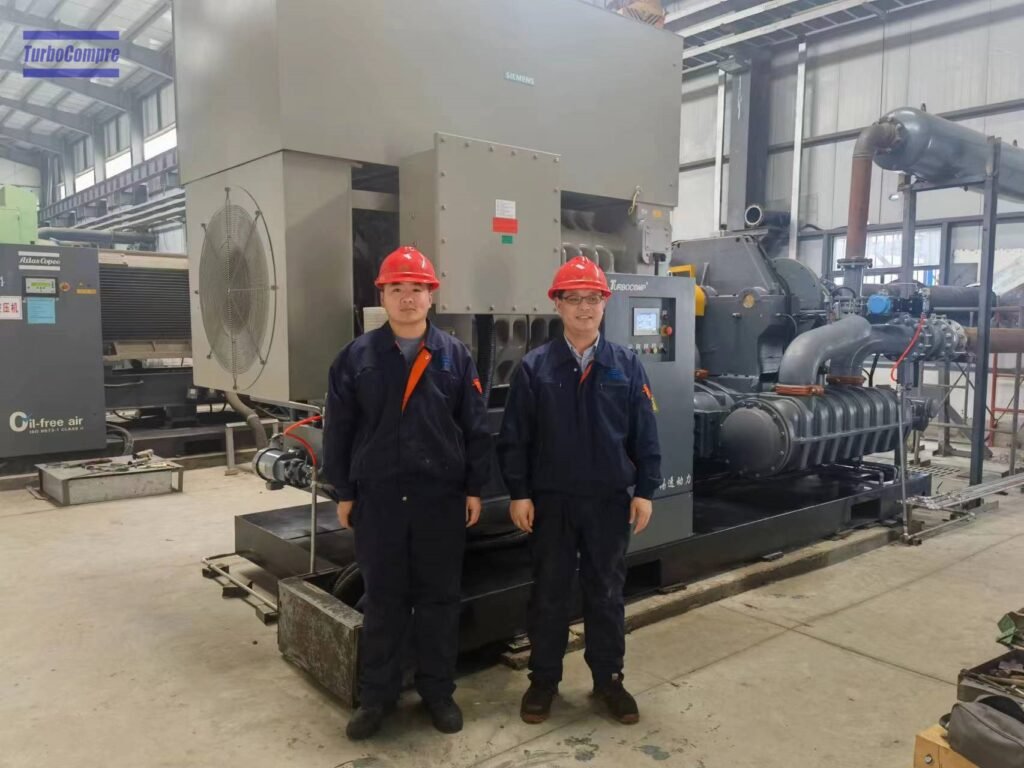
Turbo Compre provides professional customized solutions for compressor anti surge and blow off valve matching. We optimize surge control logic and calibrate safety margins according to actual working conditions, supporting complex industrial scenarios. Our high-response blow off valve products effectively solve common problems such as valve jamming, slow response and frequent false venting.