
ISO 10439-1 Standard Interpretation: Explanation of Centrifugal Compressor Performance Test Conditions
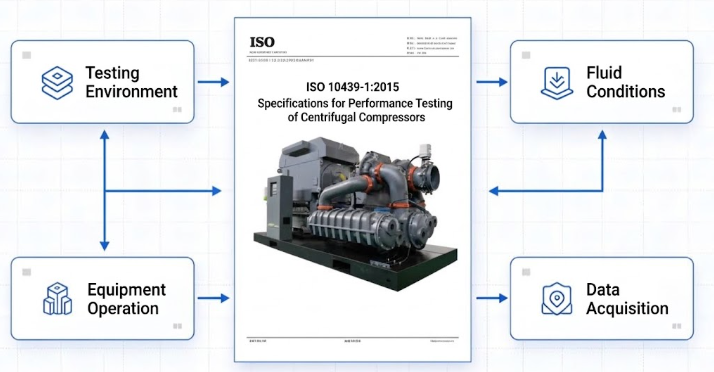
As core industrial compressor equipment in petroleum, petrochemical and natural gas sectors, the centrifugal compressor determines production efficiency and operational safety. As an authoritative international benchmark, ISO 10439-1:2015 unifies performance test conditions for this equipment, ensuring accurate test data and standardized acceptance during factory inspection and routine calibration.
Unregulated test conditions often cause data deviations and unqualified acceptance of centrifugal compressors. This article interprets core ISO 10439-1 test specifications, helping enterprises standardize testing and optimize the operation of centrifugal air compressor and process compressor units.
1. Core Positioning and Scope of ISO 10439-1:2015 Standard
The ISO 10439 series targets industrial rotating equipment , testing and delivery standards for petrochemical centrifugal compressors. It covers mainstream models and serves as thecore compliance standard for all professional centrifugal compressor performance tests.
This standard excludes low-pressure fans with boost pressure below 35kPa, while integral gear air compressors adopt ISO 10442. Its core advantage is unified industry-wide test benchmark conditions, solving the long-standing problems of incomparable test data and inconsistent acceptance standards across different manufacturers and test sites.
2. Core Test Conditions for Centrifugal Compressors
Performance testing for centrifugal compressors verifies whether equipment meets design and contractual standards by measuring key operational parameters. ISO 10439-1 defines mandatory rules for testing environment, medium, operating status and data acquisition for all industrial compressor units.
2.1 Test Environmental Conditions (Benchmark Requirements)
Compressor performance acceptance tests shall prioritize rated design conditions. Without special agreements, tests must follow standard benchmark environmental parameters to eliminate data fluctuations caused by environmental changes, Environmental parameters must remain stable throughout the test. Excessive temperature and pressure fluctuations will invalidate test results and require retesting.
-
Ambient Temperature: Controlled at 5℃~40℃. Extreme temperatures are forbidden to prevent abnormal changes in inlet air density and heat dissipation, which cause efficiency calculation deviations;
- Ambient Pressure: Based on local standard atmospheric pressure. Real-time pressure monitoring is required, and data correction must be performed for significant pressure deviations from design benchmarks;
- Ambient Medium: The test environment must be free of dust, corrosive gas and excessive condensation to avoid impurity interference with compressor operation and test accuracy.

2.2 Test Medium and Inlet Conditions
Medium status is a key factor affecting compressor performance. ISO 10439-1 standardizes test medium and inlet parameters, the main causes of common test data deviations:
- Medium Requirements: Adopt design-specified process gas or clean air; impure and unstable media are prohibited. Air substitution testing requires accurate conversion based on gas compression coefficient, viscosity and density differences;
- Inlet Temperature & Pressure: Test inlet total temperature and pressure must match rated design values with controllable deviations, ensuring the compressor operates within the design working range;
- Humidity Control: Strict air humidity control is necessary for air testing to prevent condensed water damage to internal components and eliminate humidity-related performance measurement errors.

2.3 Equipment Operating Test Conditions
ISO 10439-1 mandates three essential test conditions — rated, maximum and minimum stable working conditions — to fully verify comprehensive operating performance:
- Rated Condition Test: The core acceptance test. Steady operation at rated speed, flow and pressure is required before data collection, serving as the primary compliance judgment basis;
- Variable Condition Test: Tests operational stability, regulation performance andsurge margin under high and low loads to verify adaptability to actual production fluctuations;
- Operational Status: No abnormal vibration, noise or leakage is allowed. Bearing temperature, oil temperature, seal pressure and other auxiliary parameters must stay within standard ranges for valid test data.
2.4 Data Acquisition and Instrument Requirements
- Instrument Accuracy: All testing instruments for pressure, temperature, flow, speed and power must be fully calibrated and within validity periods, meeting standard accuracy requirements to avoid measurement errors;
- Data Collection: Continuous multiple data collection after condition stabilization, with average valid values adopted to eliminate instantaneous fluctuations and ensure objectivity;
- Data Correction: Any deviation between actual test conditions and standard benchmarks requires strict parameter correction per ISO formulas. Only corrected data is valid for acceptance.

3. Key Compliance Points for ISO 10439-1:2015 Testing
Based on industrial acceptance practices, three core compliance points must be followed to avoid common testing errors and ensure standardization:
3.1 Distinguish Benchmark and Actual Working Conditions
On-site actual condition data cannot be directly used for acceptance. All performance evaluations must rely on standard-corrected benchmark data, with on-site parameters uniformly calibrated and converted per standard rules.
3.2 Avoid Single-Condition Acceptance Testing
Single rated-condition testing fails to meet ISO 10439-1 requirements. Multi-condition tests are mandatory to verify surge margin, load regulation capability and variable-condition efficiency, ensuring full-range operational stability.
3.3 Standardize Full-Process Test Documentation
Complete test records of environmental and medium parameters, operating data, instrument certificates and correction calculations must be retained. These documents support factory acceptance, operational traceability and compliance verification.

As the authoritative testing benchmark, ISO 10439-1:2015 standardizes the whole testing process for centrifugal compressors. Strict standard compliance avoids test errors and ensures stable, efficient operation of every industrial compressor.
In refined industrial equipment management, mastering ISO 10439-1 test specifications has become an essential capability for compressor acceptance, operation, maintenance and quality control in energy and chemical industries.

Turbo Compre specializes in centrifugal compressor performance testing, calibration and operational maintenance. Focusing on petrochemical, natural gas and coal chemical industries, we provide one-stop compliant services for industrial compressor and centrifugal air compressor users, fully in line with ISO 10439-1:2015 standards. With rich on-site testing experience, our team solves non-standard testing and data deviation problems efficiently, helping clients ensure long-term stable operation of centrifugal compressors.