
Impeller Types: Structural Comparison & Selection Guide for Centrifugal Impellers

Impeller types are a core consideration for centrifugal impeller selection, which directly determines equipment pneumatic performance, operational stability and adaptability to working conditions. As a key power component of centrifugal compressors, the impeller’s structural form affects aerodynamic efficiency, pressure ratio and maintenance cycle. This article comprehensively compares three mainstream impeller types: closed impeller, semi-open impeller and open impeller, analyzing their structural features, performance advantages, performance limitations and applicable scenarios.
1. Detailed Introduction of Three Major Impeller Types
1.1 Closed Impeller
The closed impeller consists of a complete wheel disc, front wheel cover and integral blades. Double-sided enclosed flow channels eliminate radial gas leakage fundamentally, which makes it the most mature and efficient structural form of centrifugal impeller.
Performance Advantages: Excellent flow channel sealing performance, minimal gas backflow and leakage loss, delivering the highest overall working efficiency. It achievesstable gas flow without radial flow disturbance, accompanied by low equipment vibration and noise and optimal working condition stability.
Performance Limitations: It has complicated integral structure with high casting and machining difficulty. Narrow enclosed flow channels easily accumulate impurities and dirt, increasing cleaning and maintenance difficulty. Besides, it presents poor resistance to particle-containing and viscous media.
Applicable Scenarios: Ideal for high-precision compression and clean gas working conditions, widely applied to large process centrifugal compressors, air separation compressors and gas turbine supporting equipment.

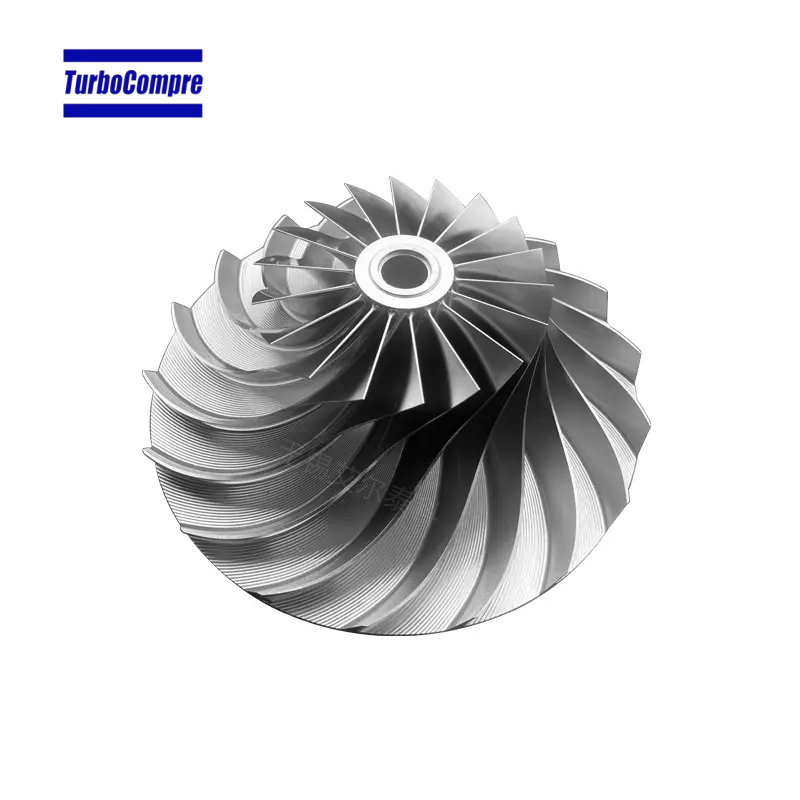
The semi-open impeller is featured with integral wheel disc and exposed blade tops without front cover. It balances high efficiency and anti-blockage performance, making it the most versatile structure for industrial compressor operation.
Performance Advantages: It balances operational efficiency and practical performance. Its efficiency is slightly lower than closed structures but far higher than open structures. The dead-free open flow channel effectively avoids blockage and simplifies daily maintenance. With high structural rigidity and outstanding high-temperature and wear resistance, it can adapt to working conditions with slight impurities and viscous media, and stably operate under medium-pressure and high-speed operating environments.
Performance Limitations: Slight gas backflow and leakage exist at blade tips, leading to a minor reduction in aerodynamic efficiency compared with closed structures.Blade tips are prone to wear after long-term continuous operation, requiring regular inspection and routine maintenance.
Applicable Scenarios: Suitable for petrochemical, metallurgy, electric power, flue gas compression and other general industrial scenarios that require both efficiency and anti-fouling performance. It serves as the mainstream structure for industrial centrifugal impeller equipment.
1.3 Open Impeller
The open impeller adopts hub-only connection structure with no wheel disc and no wheel cover. All blade flow channels are completely open, the simplest structure with the strongest medium adaptability among all structures.
Performance Advantages: It features an extremely simple overall structure, with low manufacturing, repair and replacement costs. It has zero blockage risk and excellent impurity and viscosity resistance, enabling stable operation under high-dust, high-humidity and high-viscosity medium working conditions.
Performance Limitations: Severe gas backflow and leakage loss result in the lowest working efficiency and highest energy consumption. It suffers from obvious operating pressure fluctuation and cannot meet the operation requirements of high-precision and high-pressure working scenarios.
Applicable Scenarios: Adaptable to low-pressure, low-precision and high-impurity working conditions, including sewage aeration, dust removal ventilation, and crude industrial gas delivery and treatment.

2. Comparison of Core Parameters of Three Kinds of Impellers
Core Comparison Parameters | Closed Impeller | Semi-open Impeller | Open Impeller |
Aerodynamic Efficiency | Highest | Medium-high, slightly lower than closed impeller | Lowest, large gas leakage loss |
Single-stage Pressure Ratio | Stable and controllable, medium-high pressure ratio | Strong adaptability, meets medium and high pressure working conditions | Low, only fits low-pressure working conditions |
Operation Stability | Excellent, low vibration and noise, no flow channel cross-flow | Good, stable operation under high-speed working conditions | General, obvious pressure fluctuation and narrow working range |
Anti-fouling & Wear Resistance | Limited, easy scaling, poor resistance to particle medium | Good, adapts to medium with slight impurities and viscous medium | Excellent, no blocking risk, applicable for high dust, high humidity and high viscosity medium |
Manufacturing Cost | High, complex processing technology | Medium with high cost-performance | Extremely low, simple structure for easy processing and maintenance |
Main Application Scenarios | High-precision clean gas compression, air separation, large process compressor, gas turbine supporting equipment | Petrochemical, metallurgy, power, flue gas compression and other general severe industrial working conditions | Low-pressure, low-precision, high-impurity medium transportation: sewage aeration, dust removal ventilation, crude industrial gas treatment |
3. Key Points of Impeller Selection
1. Prioritize working medium and working conditions: Select closed structures for clean gas and high-precision working conditions; semi-open structures are preferred for medium with dust and slight viscosity; open structures match transmission scenarios with high impurity content and low pressure requirements.
2. Secondly consider pressure and flow requirements: Match suitable structures according to equipment pressure and flow parameters. Closed and semi-open structures fit high-pressure and continuous operation; open structures are ideal for low-pressure conveying scenarios.
3. Finally evaluate cost and maintenance: For long-term continuous production equipment, choose closed or semi-open high-efficiency structures to cut long-term energy consumption cost; for short-cycle, low-load and harsh medium working conditions, low-cost open structures can reduce equipment investment and maintenance cost.
The selection of centrifugal impeller is essentially a comprehensive trade-off between efficiency, pressure ratio, operational stability, medium adaptability and overall cost. Different impeller types adopt differentiated structural designs to adapt to media with different cleanliness, pressure and working conditions.
As a professional centrifugal compressor R&D and manufacturing enterprise, Turbo Compre has been deeply engaged in the industry for years. Relying on mature 3D aerodynamic simulation technology, precision intelligent manufacturing system and rich working condition matching experience, we can accurately select the optimal impeller structure for various production scenarios. We provide full services including impeller structural optimization, localized customization and equipment upgrading and transformation.
