
Centrifugal Compressor: Constant Pressure, Constant Flow and Proportional Regulation Principles
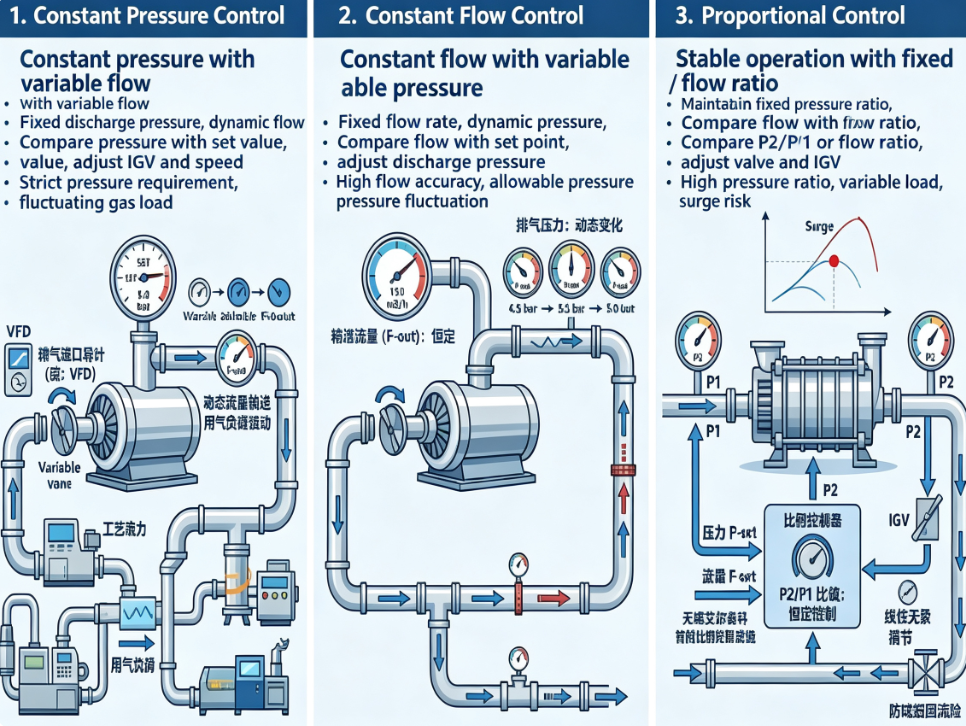
Chemical, petrochemical, air separation and power industries widely adopt centrifugal compressors for industrial gas transmission and pressurization. Stable and efficient operation relies on reliable regulation systems. Centrifugal compressors mainly support three core regulation modes: constant pressure regulation, constant flow regulation and proportional regulation. These modes differ greatly in control logic and application scenarios, serving as essential guidelines for equipment operation, maintenance and selection.
Turbo Compre is a professional manufacturer of centrifugal compressor . Focusing on R&D and manufacturing of high-performance centrifugal compressors, Turbo Compre adopts intelligent control technology to deliver precise, energy-saving and stable compression equipment for diverse industrial scenarios.
Improper use of regulation modes easily causes energy waste, unstable operation and compressor surge. This article briefly introduces the principles, advantages and application limitations of the three regulation modes to help users select suitable modes for different working conditions of centrifugal compressors.
1. Constant Pressure Regulation
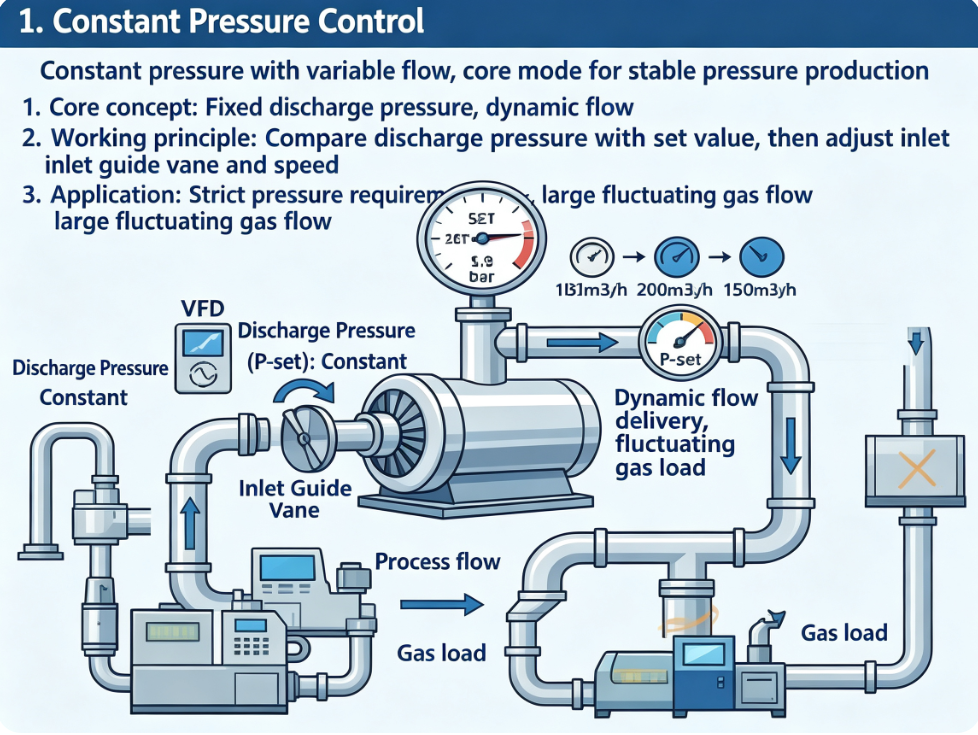
Constant pressure regulation is the most widely adopted basic control method for centrifugal compressors. Its core feature is fixed discharge pressure with variable gas flow. The system automatically matches flow output according to real-time gas consumption fluctuation to maintain stable pipeline pressure throughout operation.
The system monitors discharge pressure in real time and flexibly adjusts inlet guide vanes, operating speed and return valve opening to compensate for dynamic load changes, ensuring continuous, fluctuation-free pressure supply.
Core Advantages
This mode delivers excellent pipeline pressure stability, perfectly adapts to variable and fluctuating gas supply loads, and features simple control logic, low failure rate and full automatic unattended operation.
Application Limitations
It has limited adjustable flow range. Extremely low flow conditions may trigger surge, which must rely on supporting anti-surge systems for protection. Besides, low-load operating status will slightly reduce overall energy efficiency of the unit.
2. Constant Flow Regulation
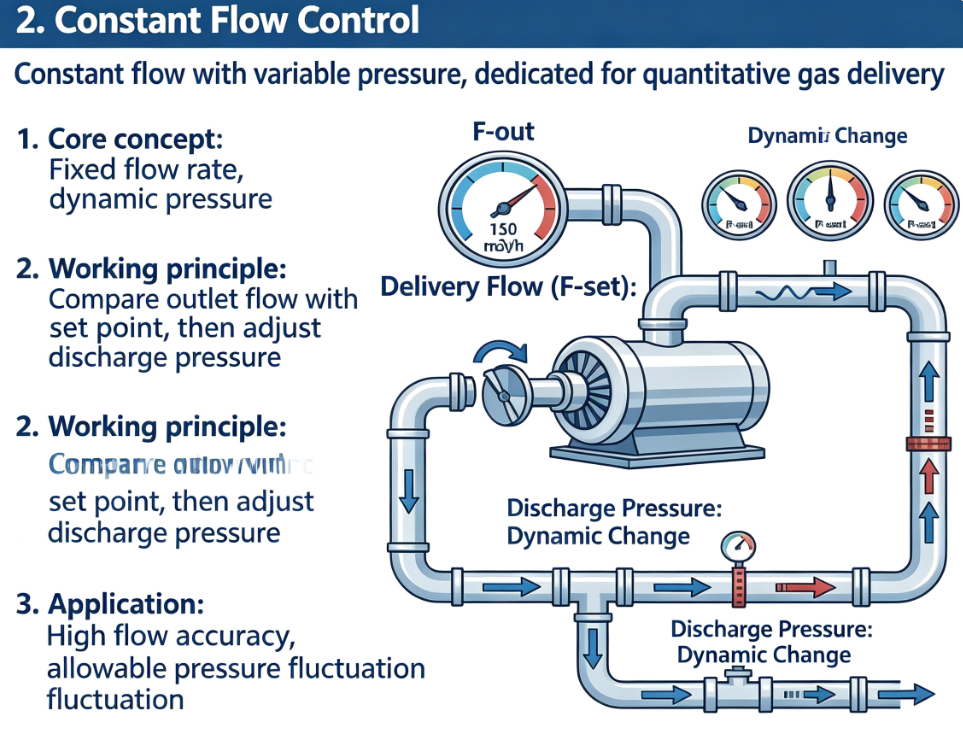
Constant flow regulation is a high-precision quantitative control mode dedicated to precision industrial scenarios. Its core feature is fixed gas flow with variable discharge pressure. The system dynamically adjusts discharge pressure to offset pipeline resistance changes and achieve strictly constant gas conveying flow.
High-sensitivity flow sensors continuously monitor outlet flow data. The compressor actively raises pressure for high-resistance pipelines and reduces pressure for low-resistance pipelines, realizing stable and accurate quantitative gas delivery.
Core Advantages
It achieves ultra-high flow control accuracy, completely eliminates flow fluctuation interference, and effectively stabilizes precision gas proportioning and chemical reaction processes.
Application Limitations
Due to dynamic pressure adjustment characteristics, this mode cannot meet strict constant-pressure production requirements. Frequent regulation actions under fluctuating pipeline resistance will cause cumulative minor equipment wear during long-term operation.
3. Proportional Regulation
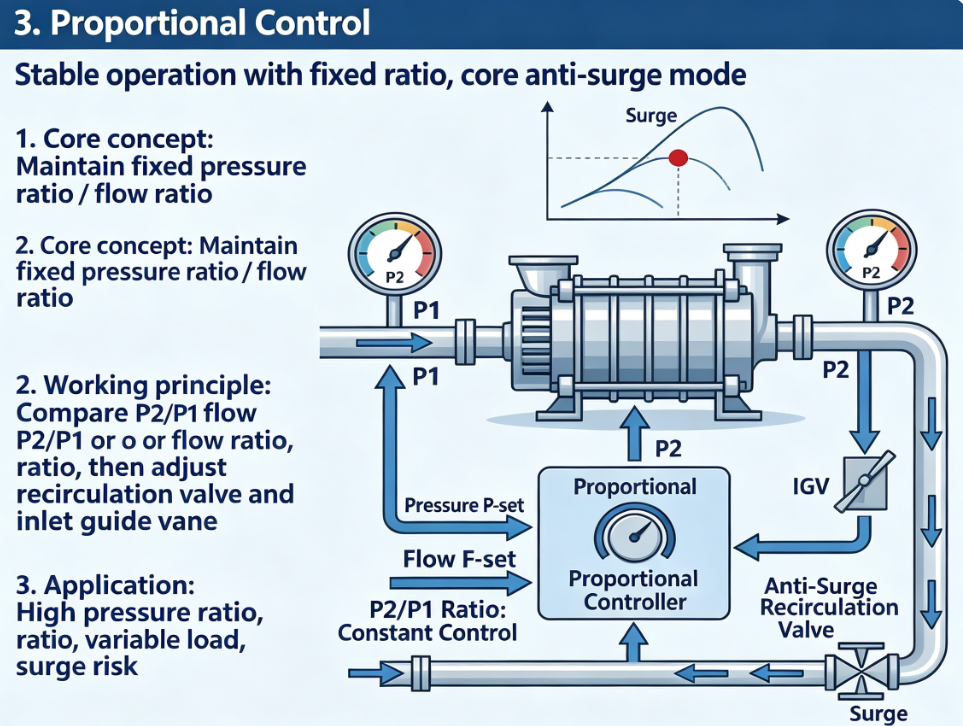
Proportional regulation is a composite dual-variable intelligent control mode that balances pressure and flow parameters, serving as the core anti-surge guarantee for high-power and high-pressure ratio centrifugal compressors. It focuses on stabilizing inlet and outlet pressure ratio or flow ratio to adapt to complex and variable working conditions.
Different from single-parameter fixed control modes, this mode takes pressure ratio and flow ratio as the core control benchmarks. It timely adjusts return valves and guide vanes to keep the compressor operating point within the safe working range and fundamentally avoid surge risks.
It adopts stepless linear regulation technology with smooth and impact-free adjustment process, effectively preventing sudden working condition fluctuations and equipment jitter.
Core Advantages
Proportional regulation features high regulation accuracy and strong working condition adaptability. It effectively eliminates compressor surge faults, perfectly adapts to variable-load complex scenarios, improves comprehensive energy efficiency and significantly extends the service life of centrifugal compressors.
Application Limitations
It requires high-precision supporting sensors and sophisticated control logic, and relies on professional manual parameter tuning and calibration, resulting in a relatively high technical threshold for equipment commissioning and daily operation.
4. Comparison of Three Centrifugal Compressor Regulation Modes
The following table intuitively compares the core differences of the three regulation modes for centrifugal compressors:
Core Comparison Dimension | Constant Pressure Regulation | Constant Flow Regulation | Proportional Regulation |
|---|---|---|---|
Core Control Parameter | Fixed discharge pressure | Fixed conveying flow | Fixed inlet/outlet pressure & flow ratio |
Operating Variable | Dynamic flow change | Dynamic pressure change | Dual dynamic adjustment of pressure and flow |
Core Function | Stabilize pipeline pressure for constant-pressure gas supply | Realize quantitative gas conveying and precise process proportioning | Prevent compressor surge and realize multi-media precise proportioning |
Applicable Working Conditions | Conventional industrial scenarios with strict pressure requirements and fluctuating gas flow | Precision chemical and manufacturing scenarios requiring high flow accuracy and allowable pressure fluctuation | Large and complex working conditions with high pressure ratio, variable load and high surge risk |
5. Mode Selection Guide and Industrial Application Summary
The three regulation modes have no absolute advantages or disadvantages, only scenario adaptability. Constant pressure regulation suits conventional industrial stable air supply scenarios; constant flow regulation fits precision quantitative production processes; proportional regulation provides key anti-surge safety protection for high-pressure ratio centrifugal compressors.
Most industrial centrifugal compressors adopt a main regulation + proportional auxiliary regulation combined strategy, realizing stable operation under normal working conditions and safety risk prevention under critical variable loads.
Turbo Compre centrifugal air compressor support intelligent multi-mode automatic switching. The built-in adaptive regulation system and professional localized services help enterprises reduce operating energy consumption and stabilize continuous production.
