
Key Instrument Data for Daily Centrifugal Compressor Maintenance

Centrifugal Turbo Compres are widely used in chemical, oil and gas, power, metallurgy and other industrial fields. As core air compression equipment, these units feature high rotating speed, high precision and extreme sensitivity to operating parameters. Most equipment shutdowns, mechanical wear and surge failures are caused by insufficient instrument data monitoring and untreated parameter abnormalities. Standard air compressor maintenance and scientific inspection are essential to achieve predictive maintenance and reduce failure rates. This article summarizes the core instrument monitoring points for daily Turbo Compre operation, forming a practical air compressor maintenance checklist for field inspection and equipment management.
Pressure, differential pressure and flow rate are the fundamental core data that judge the operating status of centrifugal Turbo Compres. A complete routine of maintenance of air compressor must prioritize these key indicators to accurately control the operating status of process systems, lubrication systems and sealing systems.

Daily inspection must focus on pressure stability and avoid sudden pressure fluctuation and sharp pressure ratio changes. Continuous low inlet pressure is usually caused by clogged air filters, pipeline leakage or insufficient upstream air supply, resulting in reduced unit efficiency.High outlet pressure with low flow rate is a typical compressor surge precursor. Operators shall check pipe network resistance and valve opening timely to prevent severe vibration and impeller damage, which is a key item in the standard air compressor maintenance checklist.
1.2 Lubricating Oil Pressure
Follow industry standard parameters: main lubricating oil pressure ≥ 0.25MPa, control oil pressure ≥ 0.85MPa. Special attention shall be paid to low oil pressure, which directly causes insufficient lubrication and dry friction leading to bearing overheating and burnout. Abnormally high oil pressure usually results from failed pressure regulating valves or blocked oil circuits, easily causing pipeline leakage and seal damage. Any pressure fluctuation requires immediate inspection of oil pumps, filter elements and pipeline conditions during daily compressor maintenance.

1.3 Key Differential Pressure Data

Focus on two core indicators: lubricating oil filter differential pressure and dry gas seal differential pressure. Lubricating oil filter differential pressure must be lower than 0.15MPa. Replace filter elements immediately once exceeding the limit toprevent impurity abrasion on bearings. Deviations in dry gas seal differential pressure indicate seal surface wear and increased leakage risk, requiring advance maintenance to avoid safety hazards of gas leakage, an indispensable step in maintenance of air compressor systems.
2. Equipment Operation Status Parameters: Predict Mechanical Failures In Advance
Temperature, vibration and shaft displacement act as the “barometer of mechanical operating status” for Turbo Compres. Almost all mechanical wear, shaft misalignment and overload operation can be reflected through these three types of data, which are critical indicators included in professional air compressor maintenance schemes.
2.1 Core Temperature Monitoring

Prioritize bearing temperature and lubricating oil temperature. According to industry standards: normal bearing metal temperature ≤ 95℃, early warning at 90℃, shutdown protection at 105℃. Sudden temperature rise is mainly caused by insufficient oil pressure, deteriorated oil quality or bearing wear. Standard lubricating oil operating temperature ranges from 40℃ to 65℃. Excessively high oil temperature is generally caused by cooler scaling and insufficient cooling water, which will accelerate oil deterioration and weaken lubrication and heat dissipation performance. Regular temperature inspection is a core part of the air compressor maintenance checklist to avoid equipment overheating failures.
2.2 Bearing Vibration Monitoring
Normal unit vibration value is stable at 4.5-7mm/s. Daily inspection focuses on sudden vibration jump and continuous rising trend. Common causes of abnormal vibration include rotor scaling, impeller wear, shaft misalignment, loose anchor bolts and pipe network stress abnormality. Long-term excessive vibration leads to component fatigue, seal failure and abnormal unit noise, which is one of the main causes of major overhauls for Turbo Compre units.
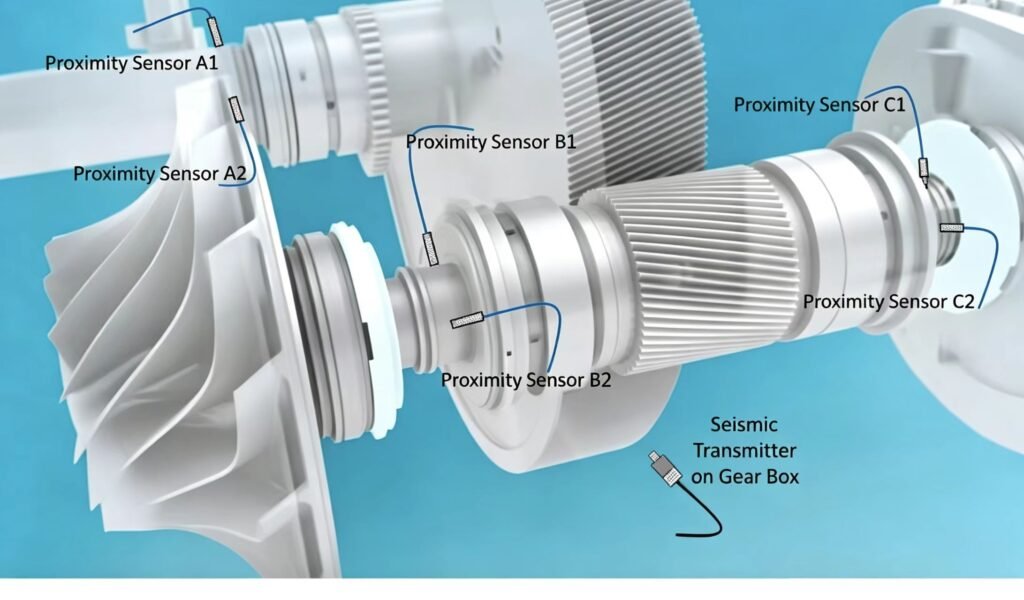
2.3 Rotor Shaft Displacement Monitoring

Shaft displacement is a core unit protection parameter and must be kept within the factory rated range. Excessive shaft displacement indicates thrust bearing wear, balance disc failure and abnormal rotor axial force, which may easily cause impeller and casing friction, internal collision and severe mechanical failures. Reduce load or shut down for inspection immediately once abnormalities occur to ensure safe operation of air compressor equipment.
In short, the key to daily turbo and air compressor maintenance is data-driven predictive management. Stabilize operating conditions and avoid surge, oil system failure and seal leakage through pressure and differential pressure monitoring; predict hidden mechanical risks such as bearing wear and rotor abnormality and prevent high-temperature burnout and severe shutdown failures through temperature, vibration and shaft displacement monitoring. Standardized inspection and abnormal handling can effectively reduce failure rates, cut maintenance costs and extend compressor service life, realizing scientific and efficient maintenance of air compressor equipment.
Turbo Compre specializes in professional centrifugal compressor maintenance, parameter calibration, fault diagnosis and systematic after-sales service. With rich experience in chemical, oil & gas, power and metallurgical industries, we own a professional technical team and standardized maintenance system. Supported by accurate data analysis, standardized inspection procedures and efficient fault handling capabilities.
