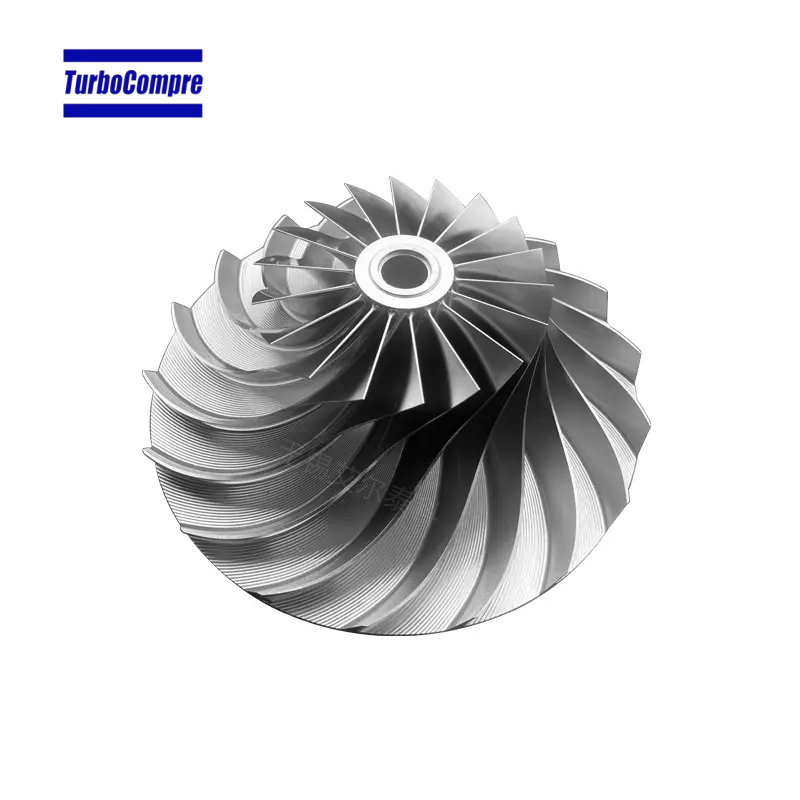
Can a Replacement Impeller Match the Original Compressor Performance?
After replacing a centrifugal compressor impeller, the machine may still operate normally—but that does not necessarily mean it performs like the original.
If the replacement is copied only by dimensions and appearance without aerodynamic matching, it may cause lower flow, insufficient pressure, higher power consumption or increased vibration.
So, can a replacement impeller match the original compressor performance?
Yes—but the goal is not simply to copy the impeller. The goal is to restore the required compressor performance.
1. Impeller Dimensions Do Not Define Performance
Centrifugal compressor impeller performance depends on much more than diameter and blade count.
Blade profile, inlet and outlet geometry, blade angles, hub and shroud contours, and flow passage design all influence the final result.
Even small geometric differences can affect flow, pressure, efficiency and operating range.
A successful replacement therefore needs both mechanical and aerodynamic matching.
2. Operating Conditions Define the Design
The replacement impeller should be designed around the compressor’s actual operating conditions.
Key parameters include: Flow + suction pressure + discharge pressure + gas properties + speed + temperature
The objective is not simply to reproduce the original geometry, but to match the required head, flow and efficiency of the compressor.
This approach is particularly useful for aging equipment, discontinued models and projects where OEM spare parts are difficult to obtain.
4. Material and Manufacturing Accuracy Matter
Correct geometry alone does not guarantee reliable performance.
A replacement impeller should also consider:
Material and mechanical properties
5-axis machining accuracy
Blade surface quality
Dimensional tolerances
Dynamic balancing
Rotor assembly accuracy
For high-speed centrifugal compressors, manufacturing quality directly affects efficiency, vibration and long-term reliability.
5. How Is Replacement Performance Verified?
A replacement impeller should not be judged only by dimensional similarity. Its impact on the complete compressor must also be evaluated.
Depending on the project, verification may include: Flow, pressure, shaft power, efficiency, vibration, dynamic balance and critical clearances.
Final acceptance criteria should be determined according to the compressor model, operating conditions and project requirements.
6. Turbocompre: From Replacement Parts to Performance Matching
Turbocompre specializes in centrifugal compressor equipment and spare-part solutions, supporting impeller inspection, reverse engineering, 3D modeling, manufacturing and dynamic balancing for aging and discontinued equipment.
Our focus is not simply to reproduce an impeller, but to engineer a replacement component that meets the performance requirements of the original compressor.
For projects involving discontinued OEM parts, long lead times, high spare-part costs or missing original drawings, this can provide a practical alternative for extending compressor service life.
Looking for a replacement centrifugal compressor impeller or localized spare-part solution? Contact Turbocompre with your compressor model and available impeller information for an initial evaluation.