
How to Select the Right Motor for a Large Centrifugal Compressor

Selecting the right motor for a large centrifugal compressor is essential for reliable operation, energy efficiency, and long-term cost control. An undersized motor may struggle under maximum operating conditions, while an oversized motor can increase capital costs and operate inefficiently under partial loads.
For industrial applications such as air separation, steelmaking, petrochemicals, and general manufacturing, motor selection must be based on the compressor’s actual performance requirements—not simply its nominal capacity.
1. Calculate the Required Motor Power
The first step is to determine the compressor’s shaft power under the full range of operating conditions. Key factors include gas flow, inlet pressure and temperature, discharge pressure, gas properties, and compressor efficiency.
The selected motor must cover the maximum required shaft power, with an appropriate design margin based on the compressor manufacturer’s recommendations and applicable standards.
For example, a compressor requiring 750 kW of shaft power cannot automatically be paired with a 750 kW motor without checking operating margins, ambient conditions, and the motor’s rated output. Engineers must also distinguish between motor output power and electrical input power, which includes motor losses.
Key point: Size the motor according to the compressor’s power requirements across its operating envelope, including relevant worst-case conditions. Avoid arbitrary oversizing.
2. Match Motor Speed to the Compressor Design
Large centrifugal compressors may use high-speed motors, conventional induction motors with speed-increasing gearboxes, or other drive configurations depending on the compressor design.
For integrally geared centrifugal compressors, the gearbox increases the impeller speed to achieve the required aerodynamic performance. Motor speed, gearbox ratio, shaft power, and impeller operating range must therefore be considered together.
A mismatch in speed or drive configuration can affect compressor efficiency, operating stability, and mechanical reliability. Motor selection should follow the compressor manufacturer’s specified drive arrangement rather than treating the motor as an independent component.
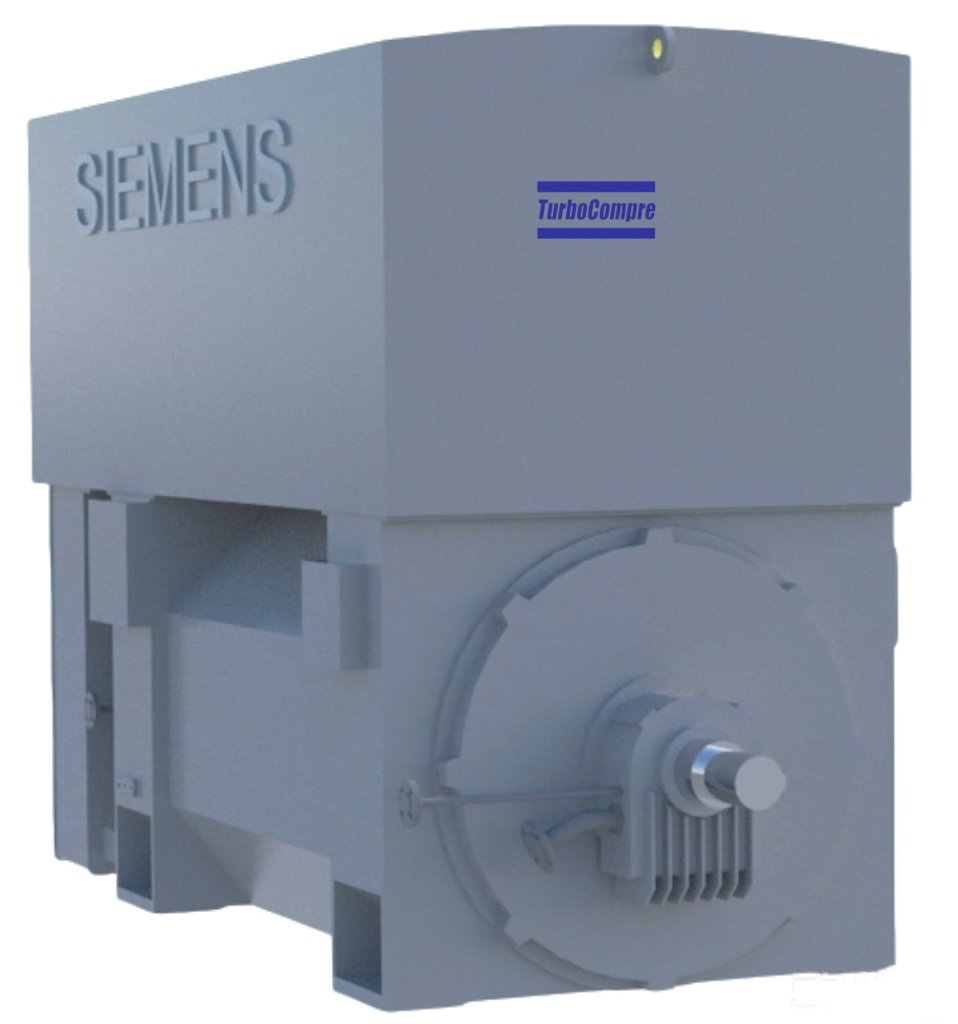
3. Choose Between Fixed-Speed and Variable-Speed Operation
A fixed-speed motor is suitable when the compressor operates near a relatively stable design point. However, plants with fluctuating air demand may benefit from variable-speed control.

A variable frequency drive (VFD) adjusts motor speed to match changing process requirements. When the compressor’s aerodynamic characteristics and control strategy allow it, this can reduce unnecessary energy consumption and improve operating flexibility.
VFD selection must account for motor insulation, cooling at reduced speeds, harmonics, electrical compatibility, and the compressor’s permitted operating range. Centrifugal compressors must also remain within their stable operating envelope to avoid surge.
Learn more about motor and drive system efficiency in the U.S. Department of Energy’s Motor Systems resources.
4. Consider Voltage, Starting Method, and Power Supply
Large industrial compressor motors often operate on medium-voltage or low-voltage systems, depending on their power rating and the plant’s electrical infrastructure.
Before selecting a motor, confirm:
Rated voltage and frequency: Match the plant’s power supply, including 50 Hz or 60 Hz operation.
Starting current: Check whether direct-on-line, soft-start, or VFD starting is appropriate for the motor and electrical network.
Starting torque and acceleration: Ensure the motor can accelerate the complete drive train within the permitted time.
Grid capacity: Verify that voltage dips and starting currents will not disrupt other equipment.
Protection and control: Specify suitable overload, short-circuit, temperature, and other required protection functions.
For large motors, starting methods should be evaluated alongside the compressor’s unloading or startup sequence. The objective is to achieve reliable acceleration without imposing unacceptable electrical or mechanical stress.
5. Evaluate Efficiency, Cooling, and Installation Conditions
Motor efficiency has a direct impact on the operating cost of a large centrifugal compressor, particularly in plants running continuously. Even a small efficiency difference can become significant over thousands of operating hours.
Compare motor efficiency at realistic loading conditions, not only at full load. Also consider power factor, cooling arrangements, insulation class, enclosure protection, bearing design, and maintenance requirements.
Ambient temperature, altitude, dust, humidity, and hazardous-area classification may affect the required motor specification. A motor installed in a hot compressor room, for example, may require specific cooling or derating considerations.
The U.S. Department of Energy provides further guidance in its Premium Efficiency Motor Selection and Application Guide.

6. Ensure Compatibility Across the Drive System
Motor selection should consider the entire compressor drive system, including the gearbox, coupling, control system, and compressor operating range. Proper matching helps avoid unnecessary energy consumption, startup issues, and mechanical stress.
For replacement projects or upgrades, engineers should also verify the existing motor’s rated power, speed, voltage, mounting dimensions, and interface requirements before confirming a new motor specification. A system-level evaluation helps ensure reliable operation and minimizes installation risks.
Contact TurboCompre for Reliable and Cost-Effective Compressor Solutions
TurboCompre specializes in large centrifugal air compressors, process gas compressors, OEM replacement spare parts, compressor repair, and energy-efficiency upgrades. With extensive experience in centrifugal compressor manufacturing and servicing major international brands, we provide practical alternatives to original equipment solutions while helping customers balance performance, reliability, and investment costs.
From complete compressor units and critical spare parts to emergency repairs, equipment refurbishment, and performance upgrades, our team works closely with customers to address specific operating challenges and extend equipment service life. We also welcome cooperation with distributors, service providers, and industrial partners seeking reliable compressor products and technical support.

Whether you are planning a new compressor project, replacing an existing motor or drive system, or looking to improve the efficiency of your current equipment, TurboCompre is ready to support your project.
Contact us today with your compressor specifications, operating conditions, or project requirements. Our team will work with you to evaluate suitable solutions that meet your technical needs while controlling long-term operating and maintenance costs.