
Domestic vs. Imported Centrifugal Compressors: A Practical Comparison

For industrial plants that depend on a stable supply of compressed air or process gas, choosing the right centrifugal compressor is an important investment decision. Imported brands have built strong reputations through years of engineering experience, established product lines, and extensive operating records. However, advances in domestic manufacturing have created more competitive alternatives for many industrial applications.
The real question is no longer simply whether to buy domestic or imported equipment. It is whether the compressor can meet the required performance, operate reliably, maintain energy efficiency, and deliver an acceptable total cost of ownership.
This article compares domestic vs. imported centrifugal compressors from a practical purchasing perspective, helping engineers, plant managers, and procurement teams make better-informed decisions.
1. Performance and Engineering Capability
Centrifugal compressor performance depends on aerodynamic design, impeller geometry, rotational speed, gearbox precision, cooling efficiency, control systems, and the integration of the complete machine.
Established international manufacturers often have extensive application experience, particularly in complex process-gas projects and specialized high-capacity equipment. Their technical track records can be valuable when a project involves demanding operating conditions or highly specific performance guarantees.
Meanwhile, capable domestic manufacturers have made significant progress in impeller design, precision machining, rotor manufacturing, dynamic balancing, and compressor control systems. For many standard industrial air applications, domestic equipment can offer a competitive alternative when its performance has been properly engineered and verified.
What buyers should check:
Guaranteed flow rate, discharge pressure, and specific power consumption.
Performance across the actual operating range, including part-load conditions.
Surge protection, control response, and operating stability.
Cooling requirements, ambient conditions, and installation limitations.
Performance test reports and clearly defined acceptance criteria.
Do not compare compressors based solely on motor power or nominal capacity. Two machines with similar headline specifications may have different energy consumption and operating flexibility.

2. Manufacturing Quality and Reliability
A compressor’s country of origin does not automatically determine its quality. Reliability depends on engineering standards, manufacturing precision, material control, assembly procedures, and quality inspection.
For high-speed rotating components, even small deviations in geometry, surface finish, or balance can affect vibration, bearing life, and long-term operating stability. This makes the manufacturer’s actual production capabilities more important than its marketing claims.
When evaluating a domestic centrifugal compressor manufacturer, ask whether it controls the manufacturing and inspection of critical components, including impellers, shafts, gears, and bearing assemblies. Also confirm how rotor balancing, dimensional inspection, assembly checks, and final testing are documented.
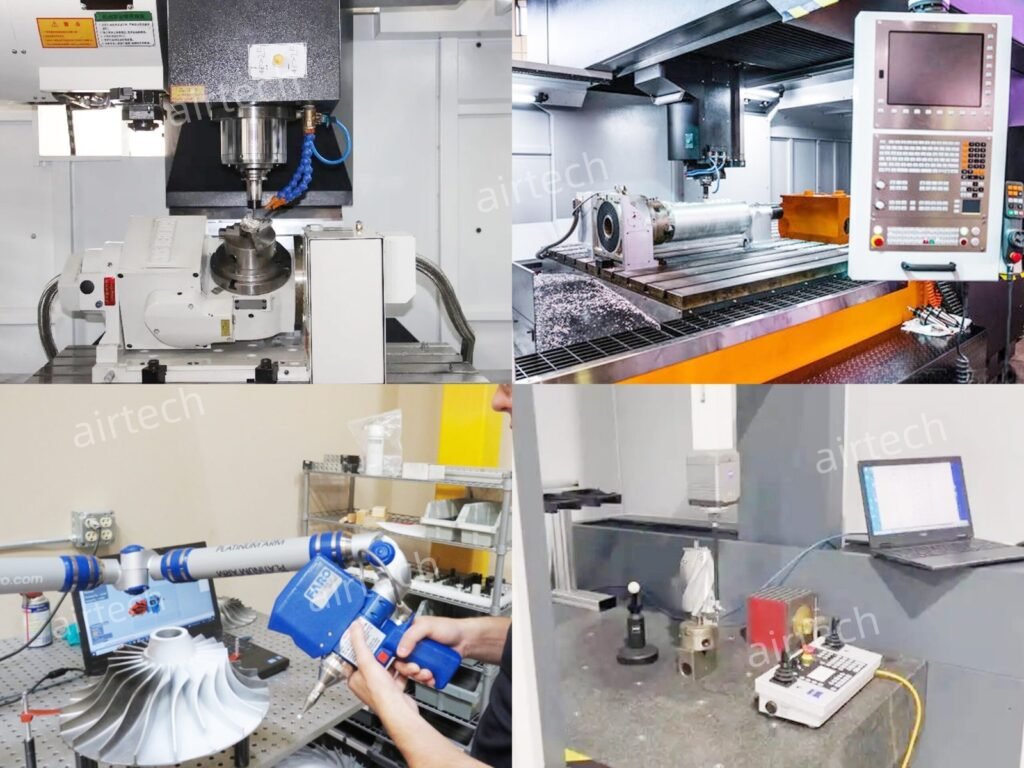
Imported equipment should be evaluated using the same criteria. A recognized brand offers valuable experience, but buyers should still review the proposed model, configuration, service history, and suitability for the specific application.
3. Initial Purchase Price and Project Investment
One of the most noticeable differences between domestic and imported centrifugal compressors is the initial investment.
Imported equipment may carry higher purchase prices due to brand positioning, international manufacturing and distribution structures, proprietary systems, and associated service arrangements. Depending on the project, additional costs may arise from international shipping, import duties, commissioning, and specialized technical support.
Domestic manufacturers can often offer more competitive pricing through localized manufacturing, supply-chain integration, and reduced dependence on overseas procurement.
However, a lower quotation does not automatically mean better value. Buyers should compare equivalent technical specifications and scopes of supply, including:
Compressor package, motor, and control system.
Cooling equipment and auxiliary systems.
Installation supervision and commissioning.
Documentation, testing, and performance guarantees.
Initial spare parts and warranty coverage.
A fair comparison requires equivalent technical and commercial conditions. The objective should be to reduce unnecessary investment without compromising performance, safety, or reliability.
4. Spare Parts Availability and Maintenance Costs
Spare parts can significantly affect the long-term economics of a centrifugal compressor, particularly in plants operating continuously.
For imported equipment, genuine OEM components may provide established compatibility and traceability. However, certain components may involve high procurement costs, international logistics, or longer delivery times, depending on availability and the supplier’s distribution network.
A qualified domestic manufacturer may provide a more flexible alternative through locally manufactured replacement parts, shorter supply chains, and direct technical communication.
For existing imported compressors, buyers may also consider technically qualified replacement parts and localized repair services. Critical components such as impellers, shafts, gears, bearings, seals, and coolers require careful engineering verification rather than simple dimensional matching.
TurboCompre supports industrial users with centrifugal compressor manufacturing, OEM-compatible spare parts, component repair, and overhaul services. For customers maintaining imported equipment, these capabilities can provide additional sourcing options and help control maintenance expenditure.

Explore TurboCompre’s centrifugal compressor spare parts solutions to learn more about cost-effective maintenance strategies.
5. After-Sales Service and Technical Response
When a compressor develops a fault, the speed and quality of technical support can directly affect production continuity.
International brands may offer established service procedures, specialist engineering resources, and global support networks. The actual response time, however, depends on the location, service agreement, technician availability, and parts inventory.
Domestic manufacturers may benefit from closer communication with the production facility, more direct access to engineering teams, and easier coordination of manufacturing, repairs, and replacement parts.
For international buyers, geographical distance should not be the only consideration. It is important to establish how the supplier handles remote troubleshooting, installation guidance, commissioning, warranty claims, and urgent spare parts requirements.
Before placing an order, ask for a clear service plan that identifies response channels, technical responsibilities, spare parts arrangements, and the availability of on-site assistance.

A competitive compressor supplier should be able to support the equipment beyond the initial delivery.
6. Energy Efficiency and Total Cost of Ownership
The initial purchase price is only part of a centrifugal compressor’s total cost of ownership (TCO). Energy consumption, maintenance, spare parts, and unplanned downtime can significantly affect long-term operating costs.
For energy-intensive applications, even a small difference in specific power consumption can lead to substantial savings over the equipment’s service life. Buyers should therefore compare actual operating performance rather than relying solely on advertised efficiency figures.
A practical TCO assessment should include:
Purchase and installation costs
Electricity consumption
Maintenance and spare parts
Downtime and production losses
Use consistent assumptions for annual operating hours, electricity prices, flow rate, and discharge pressure to ensure a fair comparison.
A well-engineered domestic centrifugal compressor can offer attractive lifecycle costs when it combines verified efficiency, reliable operation, and competitive maintenance expenses. Imported equipment may also justify a higher initial investment when its technical advantages deliver measurable long-term value.

The best choice is the compressor that meets your operating requirements at the lowest reasonable lifecycle cost—not simply the lowest purchase price.
7. Why More Industrial Buyers Are Considering Domestic Alternatives
With advances in engineering, precision manufacturing, and supply-chain capabilities, domestic centrifugal compressors are becoming increasingly competitive. For industrial buyers, the goal is not simply to find a lower-priced alternative, but to achieve the right balance of performance, reliability, and lifecycle cost.
Not every domestic compressor suits every application. Complex process-gas projects and demanding operating conditions require careful evaluation of technical capabilities, manufacturing quality, and after-sales support.
TurboCompre specializes in centrifugal compressor R&D, manufacturing, OEM-compatible spare parts, component repair, and overhaul services. We provide cost-effective solutions for new equipment projects and the maintenance of existing imported compressors.
With our manufacturing and critical-component production capabilities, we help customers optimize procurement and maintenance costs while maintaining reliable quality. Our commitment is to deliver dependable products and practical engineering solutions with the best possible cost-performance balance.

Looking for a reliable and cost-effective centrifugal compressor solution?
Visit TurboCompre’s official website to explore our products and services. Contact us with your flow rate, discharge pressure, and application requirements for a tailored technical solution and quotation.