
Wear vs Damage: How to Determine Whether a Compressor Part Needs Replacement

1. Wear or Damage? The Difference Matters
During a compressor overhaul, engineers often face the same question: Does this part really need to be replaced? A worn bearing, impeller, shaft, seal, or gear does not automatically mean it has reached the end of its service life.
Replacing every used component can increase maintenance costs, while keeping a damaged critical part can lead to vibration, efficiency loss, or even an unexpected shutdown. The correct decision should be based on measured dimensions, operating condition, material condition, and the component’s function—not appearance alone.
2. Normal Wear: When a Part May Still Be Repairable
Normal wear usually develops gradually through long-term operation. Typical examples include bearing surface wear, seal clearance increase, minor impeller erosion, and gradual wear of gear surfaces.The key is whether the remaining geometry and material condition are still within acceptable limits.
During inspection, engineers should compare critical dimensions such as clearance, shaft diameter, bearing thickness, seal gap, impeller geometry, and gear condition against the applicable drawings, specifications, or qualified repair criteria. Operational data such as vibration, temperature, pressure, flow, and performance deviation can also help establish whether the wear is affecting machine performance.

3. Damage Is Different from Wear
Damage generally indicates a more serious abnormal condition. Cracks, deep scoring, deformation, broken blades, severe erosion, overheating marks, corrosion, fretting, or significant dimensional distortion require a deeper engineering assessment. The location of the damage is just as important as its size.
A small crack on a non-critical stationary component may be repairable, while a small crack or dimensional change on a high-speed rotor can create a major reliability risk.
For special-purpose rotating equipment, API RP 687 specifically addresses inspection and repair of components such as rotors and stationary components, reflecting the importance of structured repair assessment rather than simply replacing parts based on appearance.
。
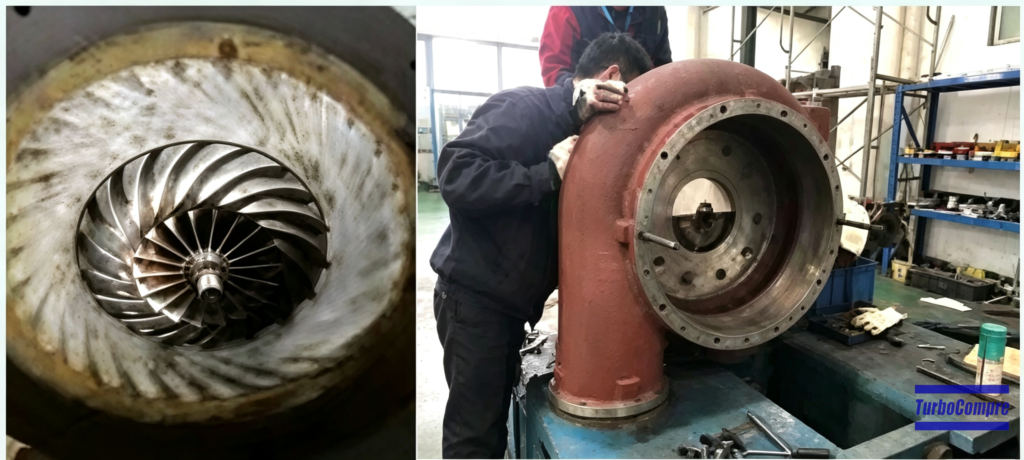
4. Which Compressor Parts Usually Require the Most Attention?
For centrifugal compressors, several components deserve particular attention during inspection:
Bearings: Check pad condition, clearances, surface damage, overheating, and dimensional changes.
Impellers: Inspect blades for erosion, corrosion, cracks, deposits, and deformation.
Shafts and rotors: Check runout, journal condition, cracks, balance condition, and dimensional tolerances.
Seals: Increased clearance, scoring, wear, or damage may cause leakage and performance loss.
Gears: Inspect tooth surfaces, pitting, scoring, abnormal wear patterns, and backlash.
Coolers: Check fouling, corrosion, leakage, and heat-transfer performance.
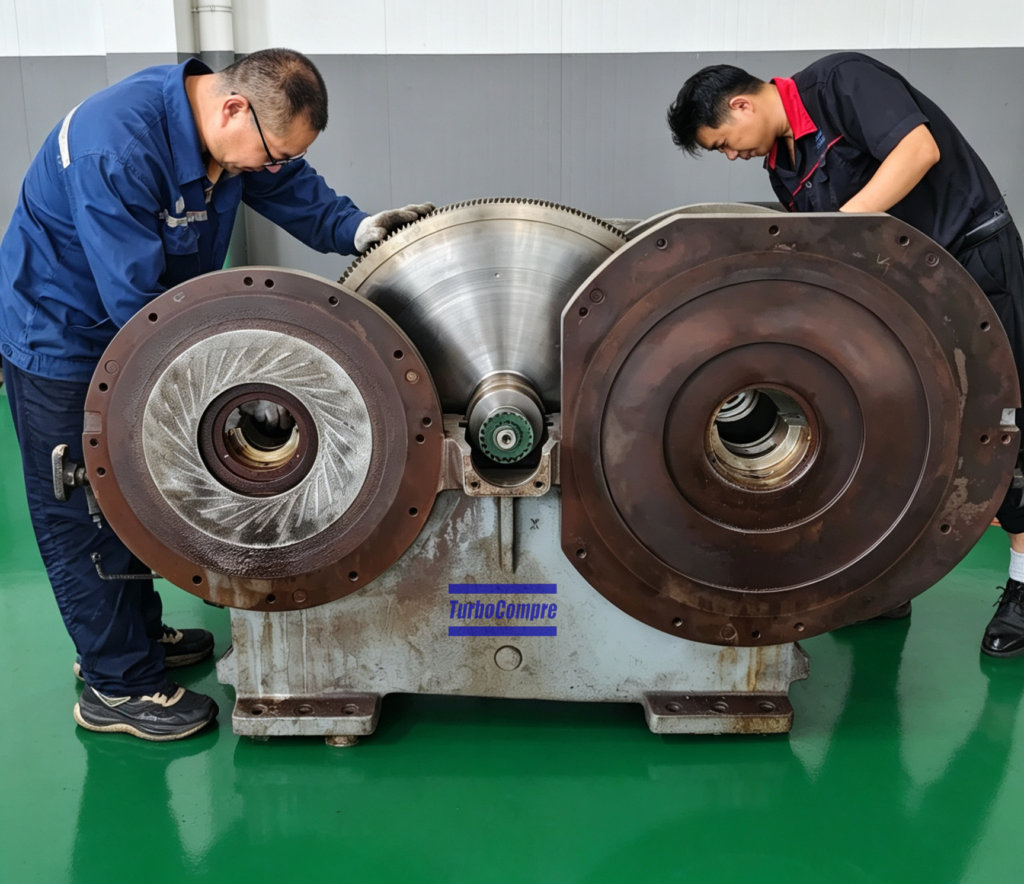
A part should not be judged independently when it is part of a rotating assembly. For example, abnormal bearing wear may be a consequence of rotor imbalance, shaft misalignment, lubrication problems, or previous repair work. Replacing the bearing without identifying the cause can simply repeat the failure.
5. Repair, Refurbishment, or Replacement?
A practical decision can follow three steps:
Step 1 — Measure: Record the actual dimensions and condition of the component.
Step 2 — Compare: Compare the measurements with original drawings, manufacturer specifications, service limits, or qualified engineering criteria.
Step 3 — Evaluate the consequence: Determine whether the condition can affect strength, balance, clearance, sealing, efficiency, vibration, or safe operation.

If the component remains within an acceptable engineering range, continued use or refurbishment may be possible. If material loss or dimensional change can be restored safely through an approved repair process, repair may be more economical than replacement. However, components with critical cracks, severe deformation, excessive material loss, or unacceptable balance/geometry may require replacement.
6. Turbocompre: Compressor Parts Inspection, Repair and Replacement
Turbocompre provides centrifugal compressor spare parts, component inspection, repair, replacement, and overhaul services for equipment from Ingersoll Rand, Atlas Copco, Hanwha, IHI-Sullair, and other major brands. For critical components such as impellers, rotors, bearings, gears, seals, and coolers, we help customers determine whether a part should be reused, repaired, reverse-engineered, or replaced based on its actual condition.
If you are dealing with compressor component wear, damage, spare parts replacement, or an urgent repair, contact Turbocompre. Share your compressor model, part name, photos, or available technical information, and our team can help assess the component condition and discuss a suitable repair or replacement solution.

Need to inspect or replace a centrifugal compressor part? Contact Turbocompre for professional spare parts and repair support.