
How to Evaluate a Compressor Manufacturer You’ve Never Worked With: A Buyer’s Guide to Quality, Reliability, and Long-Term Value

When purchasing an industrial compressor, working with an unfamiliar manufacturer can feel like a significant risk. You may receive an attractive quotation and a convincing technical proposal, but how can you know whether the supplier can deliver the promised performance, maintain consistent quality, and provide support after delivery?
For industrial buyers, distributors, EPC contractors, and plant engineers, selecting a compressor manufacturer is not simply about comparing prices or brand names. It is about finding a supplier whose technical capabilities, manufacturing processes, and long-term service commitments can be verified.
Here are six practical steps to help you evaluate an unfamiliar compressor manufacturer before making a purchasing decision.
1. Verify Whether the Supplier Is a Real Manufacturer
The first step is to understand who you are actually dealing with. Some suppliers design and manufacture their own equipment, while others assemble products, outsource most production, or operate primarily as trading companies. Each model can be suitable for different purchasing needs, but the distinction matters when technical customization, quality control, and long-term spare parts support are required.
Instead of relying solely on a company profile or website, ask for evidence of its manufacturing capabilities. This may include a factory tour, production equipment, machining and assembly facilities, inspection procedures, and examples of completed projects.
For centrifugal compressors, pay particular attention to the manufacturer’s capabilities in impeller machining, rotor and gearbox manufacturing, balancing, assembly, and performance testing. These capabilities provide a clearer picture of its engineering and production strengths than general claims about manufacturing experience.
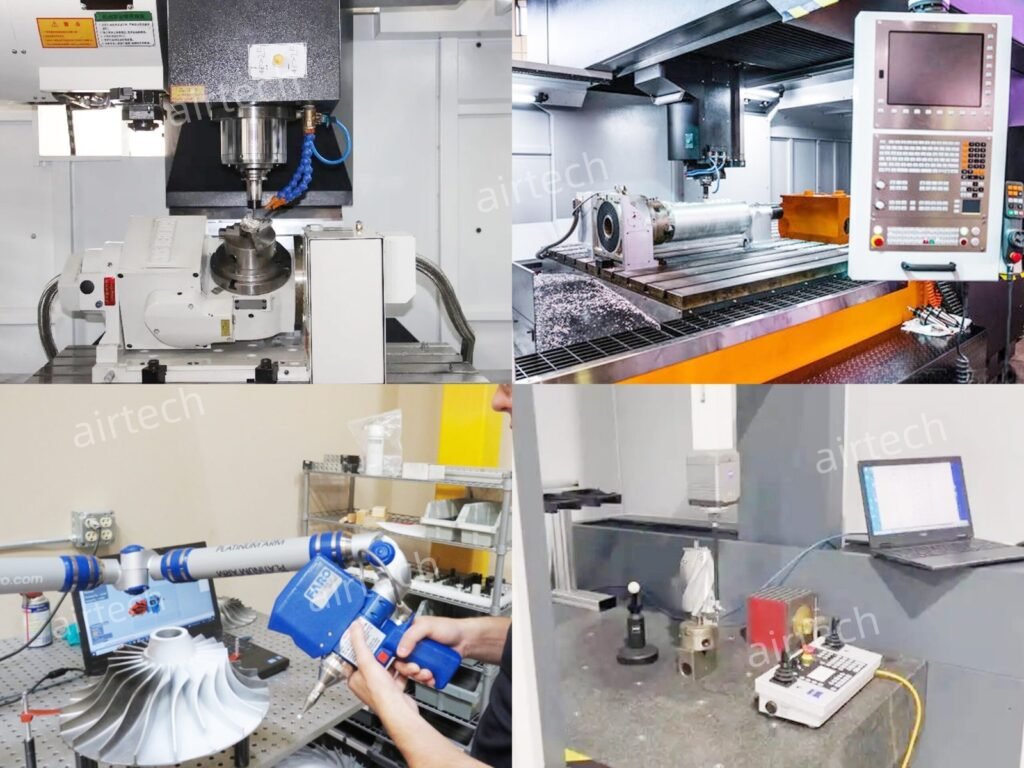
A factory visit, whether in person or through a live video inspection, can help you understand which processes are completed in-house and which depend on external suppliers.
2. Evaluate Technical Competence, Not Just Product Specifications
A compressor datasheet may look impressive, but matching a few headline specifications does not necessarily mean the machine is suitable for your application.
Before shortlisting a manufacturer, check whether its engineering team understands your actual operating conditions, including required flow rate, discharge pressure, inlet conditions, gas composition where applicable, operating temperature, cooling requirements, and expected load variations.
Ask the supplier to explain how its proposed model meets your requirements and to identify any technical deviations. For customized or process-gas applications, request relevant engineering documents, performance curves, equipment layouts, and confirmation of applicable design standards.
It is also important to distinguish between a manufacturer that can supply a standard catalogue product and one capable of engineering a solution for a specific operating condition.

For example, TurboCompre focuses on centrifugal air and process-gas compressors, including equipment for industrial applications requiring customized flow and pressure configurations. When evaluating a supplier in this category, buyers should review the proposed operating range and engineering documentation against their actual process requirements rather than relying on general product descriptions.
3. Check Quality Control and Testing Procedures
A manufacturer’s quality claims are meaningful only when supported by verifiable processes and records.
Start by reviewing its quality management certification, such as ISO 9001, where applicable. Confirm that the certificate is valid and that its scope covers the relevant manufacturing activities and facility. However, remember that a quality management certificate alone does not guarantee the performance of an individual compressor.
You should also ask how the manufacturer controls quality throughout production.
Key questions include:
How are incoming materials and purchased components inspected?
Are critical dimensions and machining tolerances documented?
What inspection procedures are used during assembly?
Are balancing, leakage, vibration, and performance tests conducted where applicable?
Can the supplier provide inspection records and a final test report for the delivered equipment?
For a major compressor project, clarify the factory acceptance test (FAT) procedure before placing the order. Agree on the test scope, acceptance criteria, documentation, and whether the customer or a third-party inspector can witness the test.
These checks help you assess whether the manufacturer has a repeatable quality process rather than relying on verbal assurances.
For additional guidance, refer to the ISO 9001 quality management standard.
4. Request Relevant Project References and Verifiable Results
A manufacturer’s years of experience are useful, but experience with projects similar to yours is even more valuable.
Ask for references involving comparable compressor types, operating pressures, capacities, industries, and service conditions. A supplier experienced in standard plant-air systems may not necessarily have the engineering experience required for a demanding process-gas application.
Where possible, request anonymized project information covering the original problem, equipment supplied, operating parameters, commissioning results, and service history. If customer confidentiality prevents the release of names, the manufacturer may still be able to provide technical case studies or arrange a reference discussion with permission.
Look beyond whether a machine was delivered successfully. Consider whether it achieved the required operating conditions, how it performed after commissioning, and whether the supplier responded effectively when technical issues arose.

TurboCompre’s project experience and compressor case studies can be reviewed through its official website. Buyers evaluating any manufacturer should apply the same standard: request evidence that is relevant to their own application and verify the claims wherever practical.
5. Assess After-Sales Support and Spare Parts Availability
Even a well-designed compressor requires maintenance, troubleshooting, and replacement parts throughout its service life. If a supplier cannot provide timely technical assistance, a minor equipment issue may develop into an expensive production interruption.
Before purchasing, establish exactly what support the manufacturer can provide after delivery.
Ask whether it offers installation guidance, commissioning assistance, operator training, preventive maintenance, troubleshooting, and emergency technical support. For international projects, clarify whether support is provided directly by the factory, through an authorized local partner, or remotely.
Spare parts deserve equal attention. Confirm availability, manufacturing lead times, pricing arrangements, and the expected support period for critical components. For specialized centrifugal compressors, ask specifically about impellers, gears, shafts, bearings, seals, coolers, and control-system components as applicable.

You should also review the warranty terms carefully. Check what is covered, how claims are handled, which party bears transportation and labor costs, and what operating conditions may affect warranty coverage.
A dependable supplier should be able to explain its support process clearly before the order is placed—not only after a problem occurs.
6. Compare Total Cost of Ownership, Not Just the Initial Quotation
An unfamiliar manufacturer may offer a substantially lower purchase price than an established international brand. That difference can create an opportunity, but it should be evaluated alongside technical risk and long-term operating costs.
A practical comparison should include:
Purchase cost: Equipment, motor, auxiliary systems, and required accessories.
Energy consumption: Power demand under actual operating conditions and expected annual running hours.
Installation and commissioning: Site work, engineering, supervision, and start-up expenses.
Maintenance: Scheduled servicing, consumables, replacement components, and labor.
Downtime risk: Potential production losses and the time needed to obtain technical support or critical parts.
For continuously operating centrifugal compressors, energy consumption can have a substantial influence on lifecycle cost. Compare performance at equivalent operating conditions and ensure that quoted efficiency figures use comparable measurement boundaries and test conditions.
The objective is not necessarily to select the cheapest manufacturer. It is to determine whether the purchase price reflects a genuine cost advantage without creating unacceptable risks to reliability, efficiency, or maintainability.
This is where a qualified alternative manufacturer may offer real value: delivering the required technical performance with a more competitive investment and a clear support plan.
Why Consider TurboCompre as an Alternative Compressor Manufacturer?
For buyers looking beyond traditional international brands, TurboCompre offers an option worth evaluating in the centrifugal compressor market.
Supported by Wuxi Airtech Compressor’s manufacturing and engineering capabilities in China, TurboCompre focuses on centrifugal compressors, industrial gas applications, and replacement parts and services for multiple established compressor brands.
Its approach emphasizes technical suitability, manufacturing control, and cost-effectiveness. For customers considering equipment replacement or aftermarket solutions, the aim is to balance dependable performance with a competitive investment rather than simply offering the lowest initial price.
As with any prospective supplier, buyers are encouraged to review relevant technical documents, inspect manufacturing capabilities, discuss acceptance criteria, and assess after-sales arrangements before making a final decision.

You do not need a long history of cooperation to evaluate a compressor manufacturer professionally. You need a structured process, relevant technical evidence, transparent commercial terms, and a clear understanding of what happens after delivery.
Looking for a reliable and cost-effective centrifugal compressor solution? Contact TurboCompre to discuss your flow rate, operating pressure, gas or air requirements, and project conditions. Our team can help you assess a suitable configuration and explore a practical solution for your application.