
Oil Lubricated Air Compressor:4 Key Indicators to Know When to Change Oil
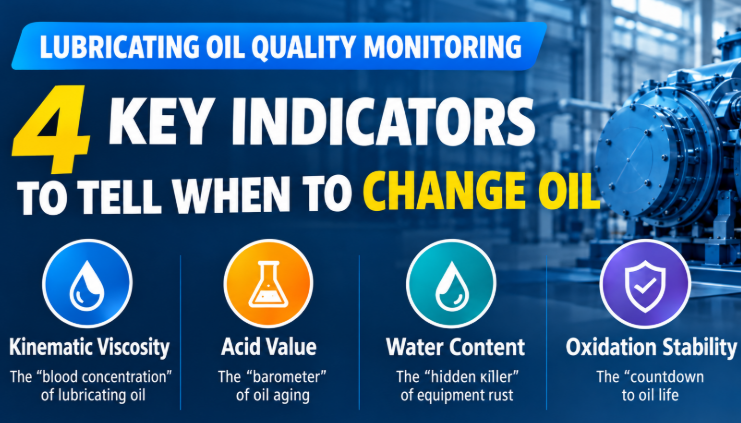
Many enterprises encounter pitfalls in industrial compressor maintenance: they change oil for compressor air purely according to fixed cycles, regardless of actual lubricant conditions of oil lubricated air compressor units. Changing oil too early causes waste; delayed oil replacement will lead to lubricant failure, further bringing about bearing wear, high temperature, abnormal noise and oil‑line blockage. In severe cases, unexpected shutdown may occur and disrupt normal production.
I. Why Monitor Lubricant Oil Degradation?
Lubricant acts as the “blood” of industrial compressors and oil lubricated air compressor equipment, undertaking core functions including friction reduction for high‑speed bearings, heat dissipation, sealing and rust prevention, as well as contaminant removal. During long‑term operation, lubricant suffers high‑temperature oxidation, contamination and additive depletion, so its performance declines step by step.
Oil degradation is a gradual and invisible process:
- Initial stage: oxidation occurs and additives are consumed slowly
- Middle stage: viscosity shifts, acid value rises and water contamination takes place
- Late stage: oil‑film strength drops sharply and bearing wear risk rises
- Severe degradation: sludge and carbon deposits form, oil circuits get blocked and unit failure may happen
Degradation cannot be judged only by oil color, smell or appearance. Professional testing on key indicators is the only reliable judgment standard. Oil change shall be carried out once test results reach critical limits.
II. Four Key Indicators of Lubricant Degradation
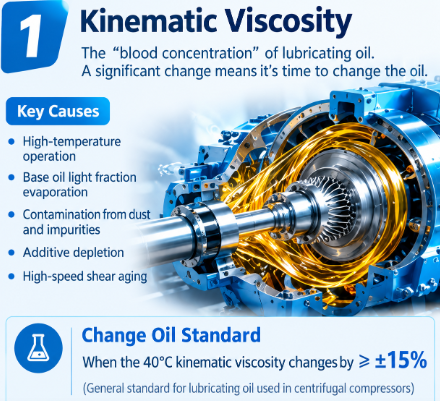
1. Kinematic Viscosity: Core Criterion for Lubrication Failure Judgment
Kinematic viscosity is the most fundamental indicator for lubricants, which directly determines oil‑film forming capacity, fluidity and sealing performance of oil for compressor air.
Hazards of abnormal viscosity
- Too low viscosity: oil‑film turns thin, metal‑to‑metal friction appears and component wear accelerates severely
- Too high viscosity: poor fluidity leads to hard startup, low heat‑dissipation efficiency, higher energy consumption, and promotes sludge and carbon deposit generation
Common causes for viscosity deviation: High‑temperature oxidation, light‑component evaporation, dust contamination and antioxidant depletion will trigger viscosity deviation in oil lubricated air compressor lubricants.
Reference threshold for oil change
- For industrial compressors and oil lubricated air compressor lubricants: conduct oil change when 40 °C kinematic viscosity varies by ±15 % versus new‑oil benchmark
In short, either sharp thickening or thinning of oil indicates unstable lubricant performance and requires immediate replacement.
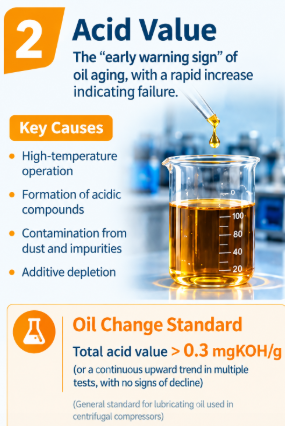
2. Acid Value: Key Indicator of Oil Oxidation and Corrosion Risk
Acid value reflects the oxidation degree of oil for compressor air and corrosion risk for industrial compressors components.
What rising acid value means: Organic substances are generated when lubricant oxidizes under operation. Continuous growth of acid value signals accelerated oil aging. Without timely treatment, bearings, gear assemblies and precision oil circuits will suffer corrosion and oil degradation will be aggravated.
Reference threshold for oil change: Pay close attention when acid value keeps climbing in consecutive tests. Replace lubricant immediately when acid value hits manufacturer‑specified limits.
Acid value shall be analyzed together with viscosity, oxidation stability and metal element content for accurate judgment.
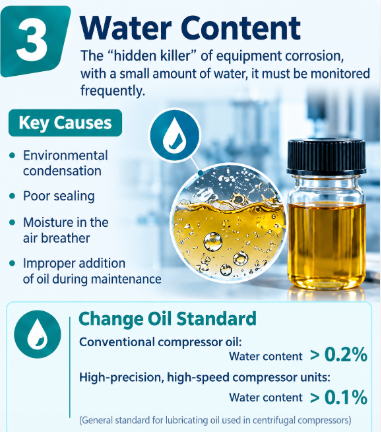
3. Water Content: Critical Standard for Oil Contamination Judgment
Water contamination is a common trouble for oil lubricated air compressor and industrial compressor lubrication systems.
Common sources of water in oil
- Seal failure
- Moist ambient air and condensate accumulation in oil tank
- Improper protection during maintenance and oil filling
Hazards of excessive water content: Water will destroy oil‑film strength completely, cause emulsification and foaming, trigger rust and corrosion, accelerate oil oxidation and sludge generation. It brings huge hidden risks to high‑speed bearings of oil lubricated air compressor units and industrial compressor equipment.
Reference threshold for oil change
- General industrial compressor & oil lubricated air compressor: replace oil when water content exceeds 0.2 %
- High‑precision compressor equipment: stricter limits apply, replace oil when water content exceeds 0.1 %
Trace water excess may exist without visible emulsification, so visual inspection is never sufficient for oil for compressor air quality judgment.
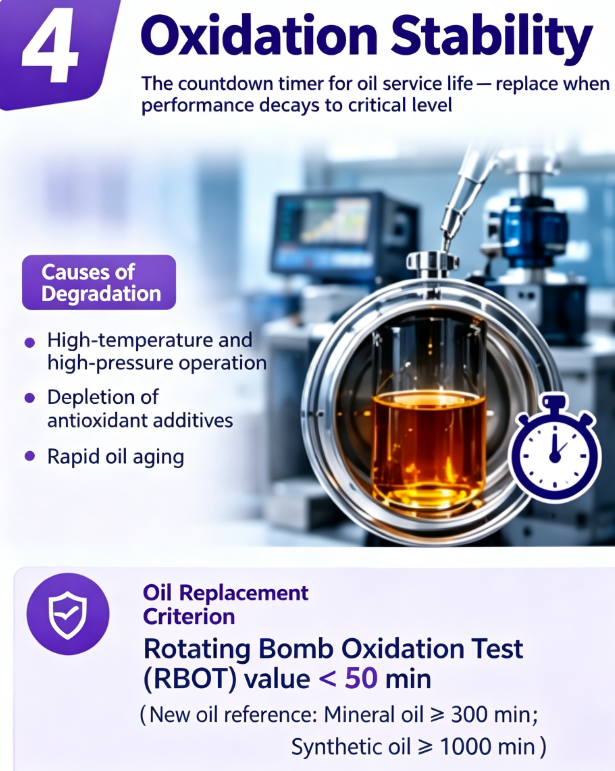
4. Oxidation Stability: Core Basis for Judging Lubricant Remaining Service Life
Oxidation stability represents the anti‑aging capacity of oil for compressor air, which is vital for evaluating residual service life of industrial compressor lubricants.
Influences of declining oxidation stability: Under high‑temperature, heavy‑load and continuous running conditions, lubricant oxidates rapidly. After antioxidants are exhausted, lubricant performance deteriorates sharply, featuring rising viscosity and acid value plus sludge generation risk.
Monitoring focus
- Continuous drop of oxidation stability
- Sustained rise of acid value
- Obvious viscosity variation
- Increased sludge and gum deposits
Arrange oil change in advance when oxidation stability approaches allowable limits.
Reference threshold for oil change: Replace oil immediately when RBOT value falls below 50 min. New‑oil reference: mineral oil ≥ 300 min; synthetic oil ≥ 1000 min.
III. Key Warning Phenomena for Potential Oil Degradation
Apart from professional lab test indicators, watch out for the following on‑site symptoms which signal abnormal lubricant status and hidden degradation risks:
- Remarkable oil darkening in short time: usually caused by high‑temperature oxidation or contamination
- Sludge, gum or sediment formation: may block oil circuits and filters
- Heavy and persistent foaming: related to additive failure or water contamination
- Pungent or burnt smell: hinting high‑temperature oxidation
- Frequently blocked filters: indicating rising contaminants and oxidation products
These phenomena alone may not require immediate oil replacement, but professional lab testing must be arranged promptly to avoid industrial compressors failure.
Lubrication management for oil lubricated compressor and industrial compressor systems should never rely merely on experience. Variation of key test indicators offers the most reliable reference for oil‑change timing. Through regular sampling, professional testing and trend analysis, enterprises can obtain real lubricant status and avoid drawbacks of both premature and delayed oil‑change for oil for compressor air.

Turbo Compre delivers targeted oil analysis and lubrication management support for industrial users. For oil lubricated air compressor and industrial compressor lubricants, Turbo Compre helps customers build standardized oil monitoring workflows for oil for compressor air around core indicators including viscosity, acid value, water content and oxidation stability. It helps shift oil‑change decisions from time‑based schedule to data‑driven standards, effectively reducing equipment failure risks and cutting overall maintenance costs.