
Turbo Compressor Replacement: Pre-Retrofit Survey & Budget Evaluation Guide

Centrifugal compressors are core compressed-air supply equipment for industrial production. Long-term operation of old units leads to high energy consumption, high failure rate, unstable air supply and high O&M costs, hindering production efficiency and cost control. Driven by carbon-neutral policies and rising energy costs, turbo compressor replacement has become a key measure for manufacturers to save energy and improve productivity.
The success of centrifugal compressor replacement relies on accurate pre-project site surveys and scientific assessment of compressor replacement cost. Most industrial renovation problems including equipment mismatch, budget overruns, poor energy-saving effects and construction delays stem from inadequate investigation and rough budgeting. This article summarizes key survey standards and cost-control skills for industrial air station renovation.
1. Key Points for Pre‑retrofit Site Survey of Centrifugal Compressor Replacement
Pre-renovation site surveys aim to clarify old unit operating status, match new equipment parameters, eliminate supporting risks and confirm construction conditions for equipment upgrade, covering five core modules: equipment operation, site space, electrical system, air piping and environmental supporting facilities, which are essential for reliable renovation.
1.1 Survey of Existing Unit Operating Conditions to Clarify Replacement Requirements
Detecting the operating status of aging units is the basis for customized renovation solutions, which effectively avoids unreasonable model selection and controls overall compressor replacement cost.
- Basic parameter inspection: Record the rated and actual operating parameters of old compressors, and check the wear of core components such as impellers and bearings to evaluate equipment aging and failure causes.
- Air consumption monitoring: Conduct 72-hour continuous air consumption testing to obtain actual load data. Calculate demand via the formula: Actual air capacity = Total air consumption × Simultaneity factor × 1.2 safety margin (0.8-0.9 for assembly lines, 0.6-1 for discrete equipment). Reserve 15%-25% capacity for future expansion.
- Economic evaluation: Count annual maintenance costs and shutdown losses. Replace old equipment if two-year cumulative maintenance costs exceed 35% of residual value, one overhaul cost reaches 40% of new unit price, or annual unplanned downtime exceeds 200 hours.
- Energy efficiency testing: Detect specific power and energy loss of old units, compare with modern high-efficiency standards, and calculate energy waste to support energy-saving benefit evaluation.
1.2 Site‑space Survey to Guarantee Installation Compatibility
New centrifugal compressors differ greatly from old industrial models in size, weight and structure. On-site measurement is essential to avoid installation and adaptation problems during renovation projects.
- Space measurement: Measure compressor room dimensions, reserve space for maintenance and heat dissipation, and confirm equipment access and hoisting paths to avoid structural obstructions.
- Foundation detection: Inspect foundation flatness, bearing capacity and damping performance. Arrange reinforcement and leveling in advance for unqualified foundations to prevent vibration and equipment faults.
- Layout optimization: Reasonably plan the placement of new compressors, post-processing equipment and air storage tanks to facilitate daily maintenance.
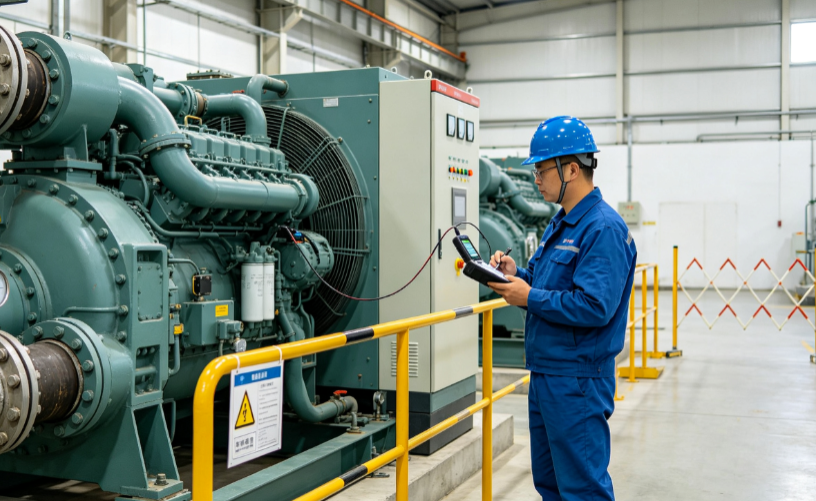
Centrifugal units are high-power precision equipment. Mismatched electrical systems easily cause startup failure, frequent tripping and component burnout, which are common renovation faults in replacement projects.
- Power capacity verification: Confirm transformer residual capacity, cable specification and distribution cabinet parameters to meet new unit power and startup current requirements.
- Circuit inspection: Check line aging, grounding protection and voltage stabilization performance to ensure stable signal transmission for new unit frequency conversion and intelligent control systems.
- Metering configuration: Verify electric meter accuracy and set up independent metering points for new units to monitor power consumption and calculate energy-saving benefits.
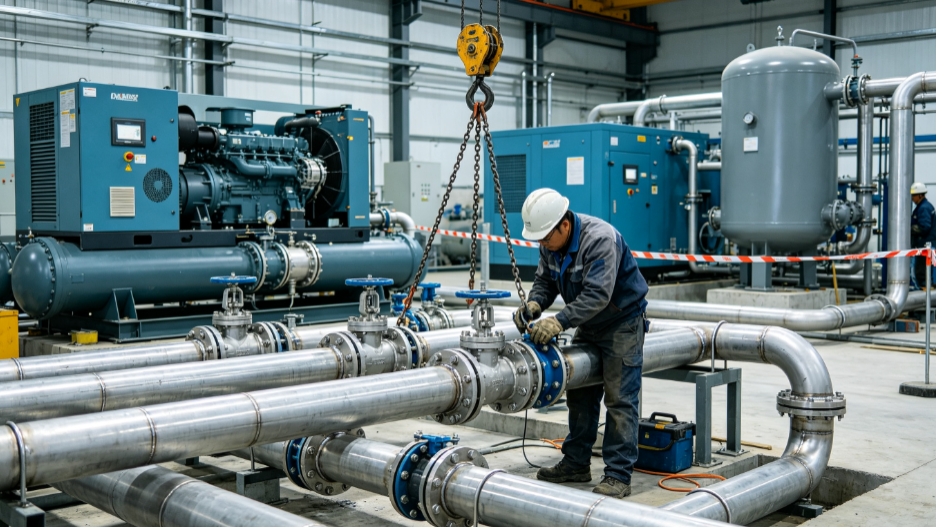
1.4 Compressed‑air Piping Survey to Minimize Transmission Loss
Air piping is a key part of the industrial air supply system. Aging and leaky pipelines will offset the energy-saving advantages of new centrifugal compressors, making comprehensive piping inspection indispensable for every renovation project.
- Pipeline loss testing: Detect pipe tightness and pressure loss, and reserve sufficient pressure margin for new units to guarantee terminal air supply pressure stability.
- Aging diagnosis: Check pipeline corrosion and blockage, and mark outdated pipelines, valves and filters for replacement or renovation.
- Supporting equipment matching: Verify the adaptability of dryers, filters and air storage tanks to new unit parameters, and ensure smooth condensate drainage.
1.5 Ambient & Auxiliary‑facility Survey to Meet Operation Specifications
- Ventilation and heat dissipation: Centrifugal compressors produce huge heat. Optimize ventilation conditions to avoid heat accumulation and high-temperature shutdown faults.
- Noise and vibration control: Evaluate on-site noise and vibration, and configure sound insulation and damping facilities as required to meet environmental protection standards.
- Environmental compliance: Check condensate disposal conditions to ensure the renovated system meets regulatory requirements.
2. Budget Evaluation Methodology for Centrifugal Compressor Replacement
Most enterprises only budget for equipment procurement and ignore hidden costs such as demolition and renovation, causing compressor replacement cost overruns. Scientific evaluation adopts the full-life-cycle cost accounting method, covering one-time investment and long-term operating costs for accurate project benefit assessment.
2.1 One‑time Capital Investment (Direct Core Costs)
One-time investment is the core explicit expenditure of the renovation project, covering all quantifiable upfront costs.
- Equipment procurement: Accounting for60%-70% of total budget, including host, motor and intelligent control system. Prioritize specific power, energy efficiency and core quality rather than low price alone.
- Old unit disposal: Covering disassembly, hoisting and cleaning; old equipment residual value can offset new machine costs to reduce investment.
- Installation and commissioning: Including equipment positioning, piping and wiring construction, startup debugging and system calibration, priced by construction difficulty and working hours.
- Supporting renovation: Easily overlooked hidden costs including foundation reinforcement, circuit and piping upgrade, heat dissipation and noise reduction transformation, fully itemized based on survey data.
- Filing and acceptance: Including project documentation, equipment inspection, energy efficiency verification and archiving fees.
2.2 Long‑term Operating Costs (Core of Full‑life‑cycle Budget)
Low upfront cost cannot guarantee long-term cost performance for centrifugal compressors. Operating costs must be included in cost evaluation to objectively assess the economic benefits of turbo compressor replacement projects.
- Energy cost: New compressors with 3D flow impellers and high-efficiency VFD save 15%-30% annual power. Calculate annual power consumption and energy-saving benefits based on operating hours and local electricity prices.
- Maintenance cost: High-quality new units feature low failure rates and long overhaul cycles, effectively reducing annual maintenance expenses and production shutdown losses.
- Depreciation cost: Amortize total investment within the 5-10 year service life to evaluate long-term comprehensive cost performance.

2.3 Core Budget‑evaluation Formulas & Return Calculation
- Total project investment = Procurement + Demolition & Construction + Supporting Renovation + Commissioning + Annual O&M Cost
- Annual energy-saving benefit = Old unit annual cost − New unit annual cost (power + maintenance)
- Payback period = Total investment ÷ Annual net energy-saving benefit
Qualified centrifugal compressor replacement projects have a 2-4 year payback period and over 10-year service life, delivering stable long-term economic returns for industrial air system upgrades.
2.4 Budget Risk‑control Guidelines
- Reserve 10%-15% budget contingency for unexpected construction adjustments and price fluctuations to avoid overspending.
- Prioritize mandatory renovation items and delay non-essential upgrades to control initial investment scale.
- Compare multiple suppliers’ quotations, distinguish configuration and warranty differences, and avoid low-price but low-quality traps.
Centrifugal compressor replacement is a systematic industrial project focusing on safety, energy efficiency and economy. Accurate pre-renovation surveys lay the foundation for successful renovation, and scientific budgeting controls overall project costs to guarantee project profitability.
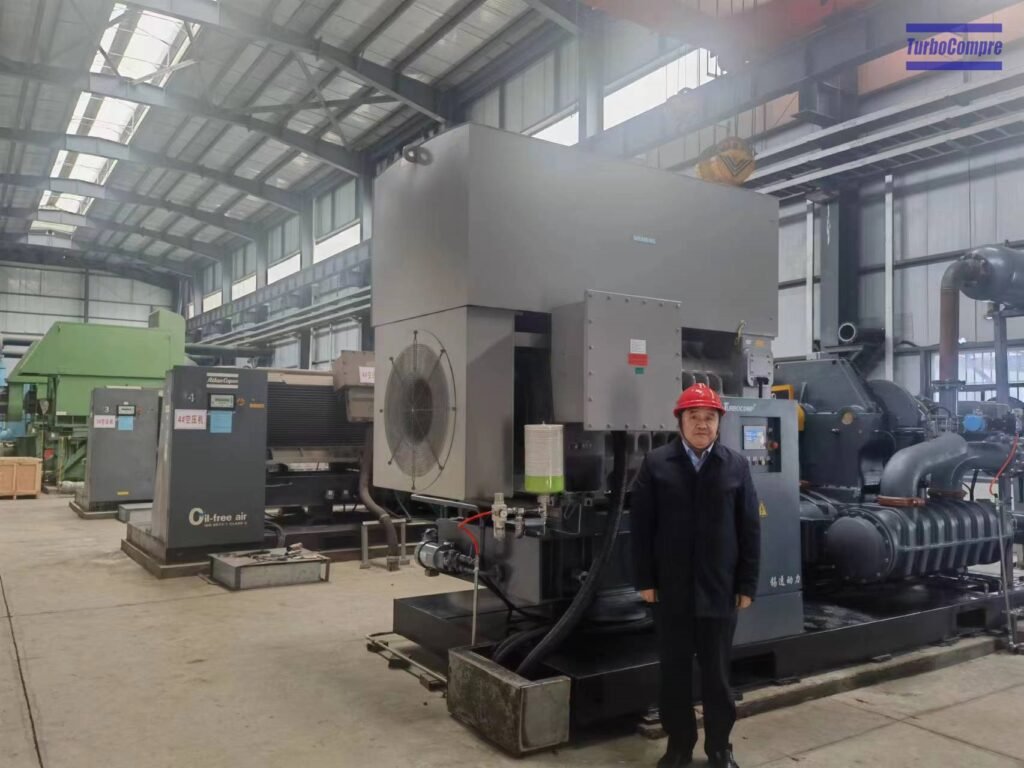
Enterprises need full-coverage on-site surveys and full-life-cycle budget evaluation to avoid improper selection, construction risks and cost overruns during equipment renovation.With standardized survey processes, rigorous cost management, high-efficiency centrifugal compressors and complete after-sales service, Turbo Compre serves multiple industries, helping enterprises complete turbo compressor replacement upgrades and realize energy saving, cost reduction and green manufacturing.